

Creative Challenge #1: Real Stories in a Regulated Category
Context: Health advertisers live under strict claims rules. A testimonial cannot promise a result the speaker has not lived, and the company had its own rules on what could appear on camera.
Outcome:
- Cast creators who live with the problem or share a home with someone who does, so every story is real.
- Checked every claim before filming and wrote the company rules into each brief.
- When footage missed a rule, it was refilmed, not forced into the edit.
Creative Challenge #2: Many Angles, Not One Hero Ad
Context: One winning ad burns out fast at high spend. The account needed a deep bench of distinct ideas.
Outcome:
- Scripted UGC from practitioners and everyday people, problem and solution skits, podcast-style conversations, and no-creator explainer videos.
- Every ad tested one idea, with several hook variations on top.
- Editorial-style statics ran next to the video to cover the same angles in a different format.
Creative Challenge #3: Staying Fresh While Spend Scales
Context: Spend grew about 7.6x. Creative fatigue grows with it.
Outcome:
- Shipped a new slate every month, about 28 new ads a month on average and 50 or more in the biggest months.
- Scaled winners, retired fatigued ads and fed what worked into the next brief.
- Creative and media buying ran as one loop, so the account data wrote the next month's brief.
Performance: From $70K to $535K a Month
Context: UGC Factory ran creative and media buying for this health tech company on Meta. The account started at about $70K a month, with no UGC Factory ads running. Twenty months later it spent about $535K a month, and two thirds of that went to ads we made.
Results (Meta, rounded, by month of the engagement):
- Spend grew about 7.6x, from about $70K in Month 1 to about $535K in Month 20.
- 67% of Month 20 spend went to UGC Factory ads. Over the whole engagement the share is about 50%, roughly $2.8M of $5.6M.
- 550+ UGC Factory ads earned spend. 39 spent more than $10K each, 14 spent more than $50K and 7 spent more than $100K.
- The top ad alone spent more than $225K.
- Purchases grew from about 250 a month to about 2,050.
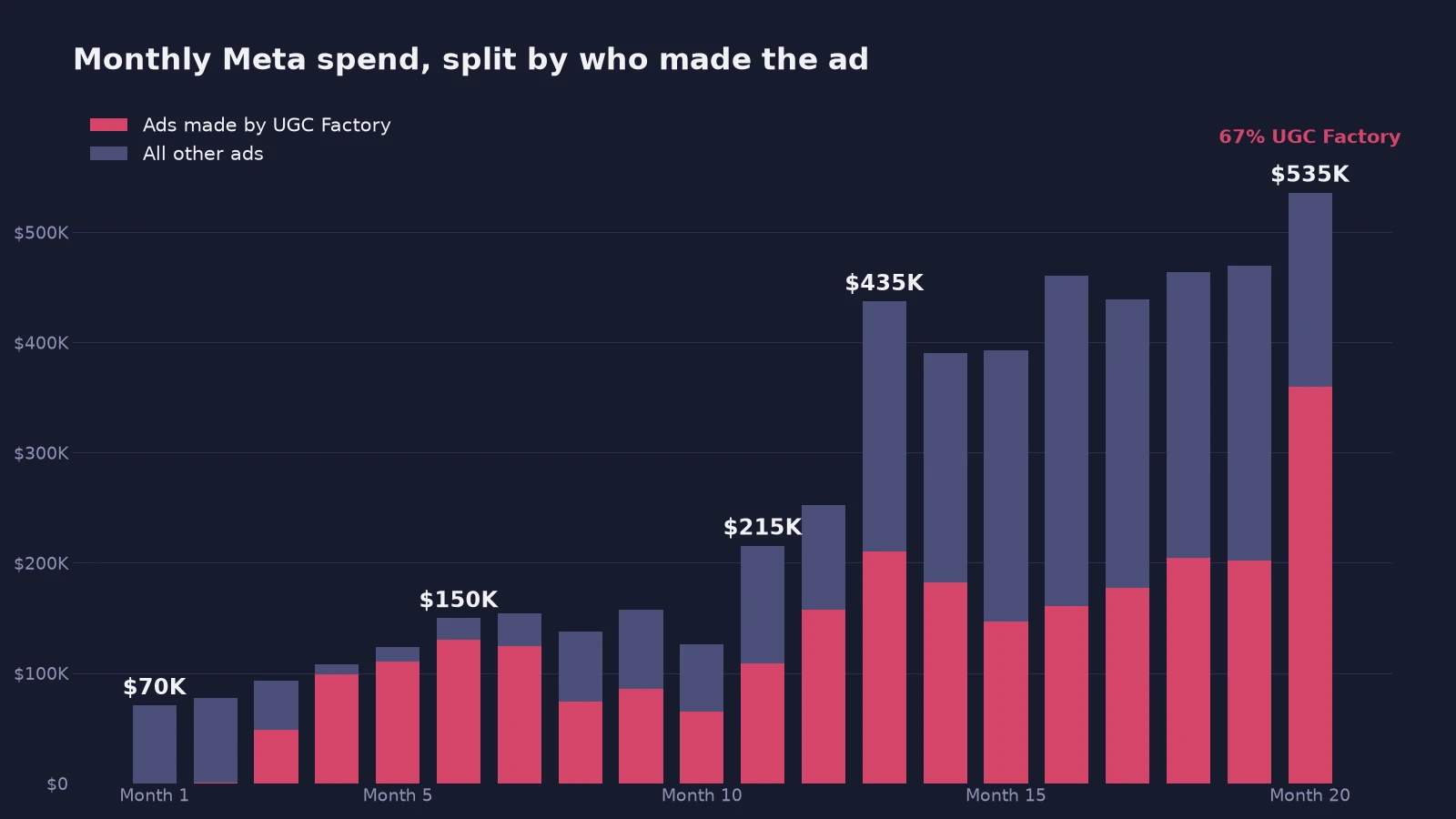
How the growth unfolded:
- Months 1 to 2: $70K to $77K. The first 8 UGC Factory ads went live in Month 2.
- Months 3 to 7: $93K to $154K. Our ads took over the account, reaching 91% of spend in Month 4. Cost per purchase fell from about $300 to about $140.
- Months 8 to 10: $138K to $126K. Spend dipped while we rebuilt the slate around the angles that had won.
- Months 11 to 12: $216K to $252K. The rebuilt slate more than doubled monthly purchases and hit the account's lowest cost per purchase, about $110.
- Month 13: $437K. Spend jumped 1.7x in a single month on the strength of proven winners.
- Months 14 to 19: $390K to $470K. The account held the new level while we kept testing volume, with our share of spend near 40 to 45%.
- Month 20: $535K. A fresh round of winners pushed our share to 67% and purchases back above 2,000.
Efficiency: Cost per purchase fell about 60% on the way from Month 1 to Month 11 while spend tripled. It rose as spend moved past $400K. At $535K in Month 20 it sat at about $260, below the Month 1 level of about $280.
What made it work:
- Volume with a point of view. A deep monthly slate, each ad built to test one idea.
- Real people with the real problem. Cast for it, not acted.
- Hook testing. One idea, many openings, winners scaled fast.
- One loop. Media buying and creative shared the same data, so what scaled in the account shaped the next brief.