Beauty UGC Ads: What 748 Ads From 25 Brands Reveal (2026)
We analyzed 748 beauty ads from 25 DTC brands to see which were still running after 30 days. Founder ads held at twice the rate of standard UGC, authority hooks led, and default TikTok captions lagged.
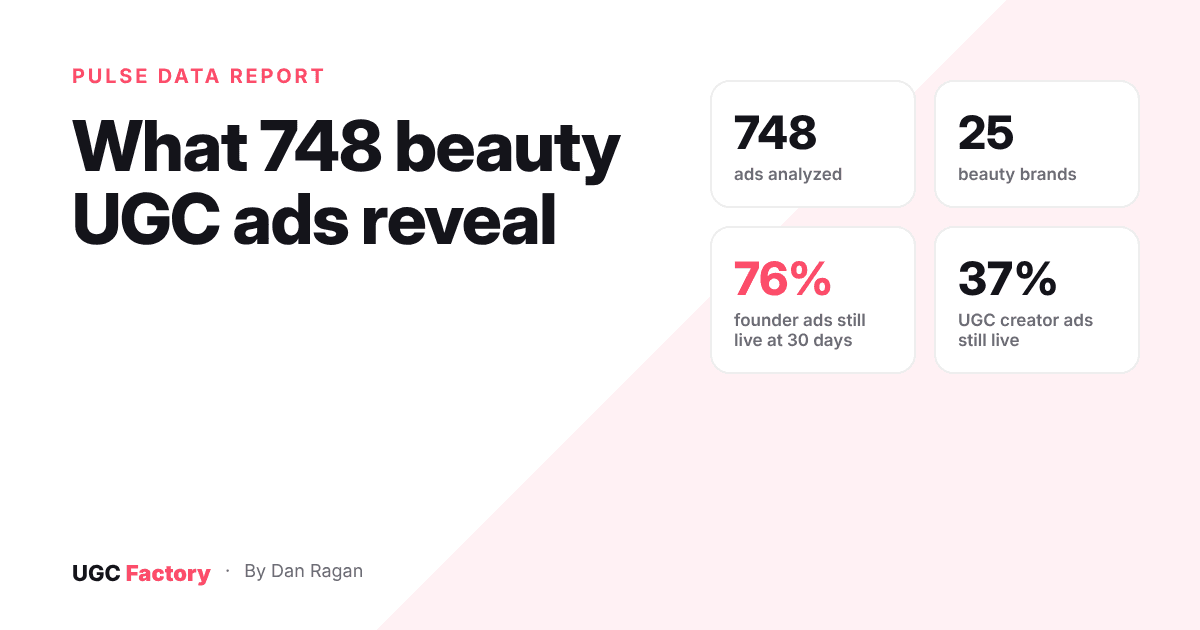
Table of Contents
Most beauty ad advice is built on a few viral examples. This report is built on 748 of them.
We track the live Meta ads of top DTC brands in our Pulse database. For this report we pulled every beauty ad launched between October 2025 and August 2026: 748 ads from 25 brands across skincare, haircare, makeup, fragrance and body care. Each ad was broken down by who's on camera, hook type, caption style, format and more.
Then we asked one question: which ads were still running 30 days after launch? Brands don't keep paying for ads that don't work, so staying live is the clearest public signal of a winner. Across all 748 ads, 42% made it past 30 days. That's a tougher bar than supplements, where 60% did. Here's what separated the beauty ads that survived.
1. Founders and the brand's own team beat generic UGC by 2 to 1
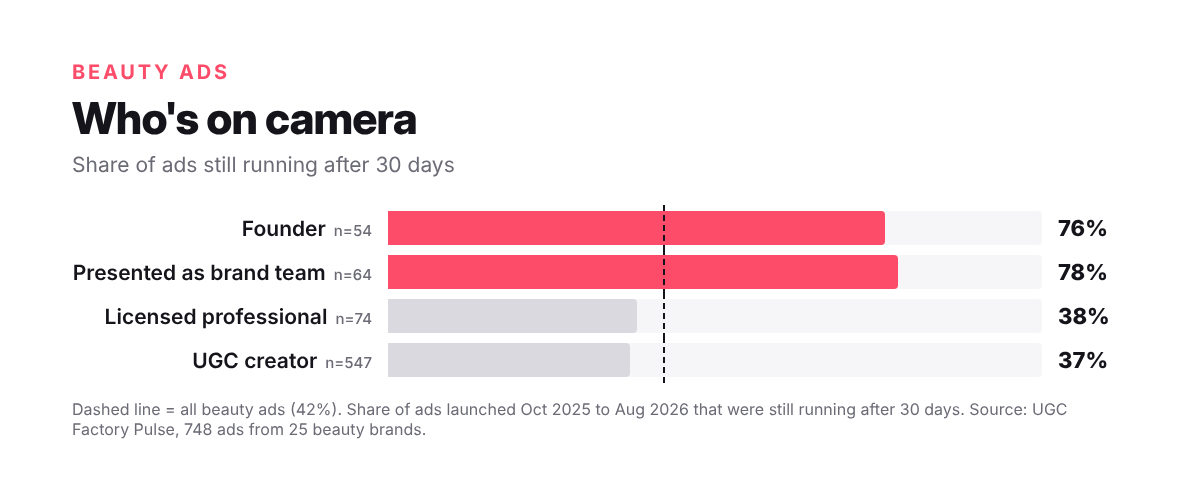
UGC creators made 547 of the 748 ads, nearly three in four, and only 37% of them were still live after 30 days. Ads fronted by the founder (76%) or by someone presented as part of the brand team (78%) held at about twice that rate.
This isn't one brand skewing the numbers. With the single biggest brand removed, founder ads held at 85% and brand-team ads at 86%.
The surprise is licensed professionals. Dermatologists, estheticians and stylists ran at 38%, no better than average UGC. In beauty, a credential on screen isn't enough on its own. Buyers respond to the person who made the product.
What to do with this: keep creators as your volume engine, but every batch needs founder and team content. A founder walking through why a formula exists, or a team member using the product on camera, is the highest-percentage bet in the category.
2. Authority hooks hold. Most other hooks don't.
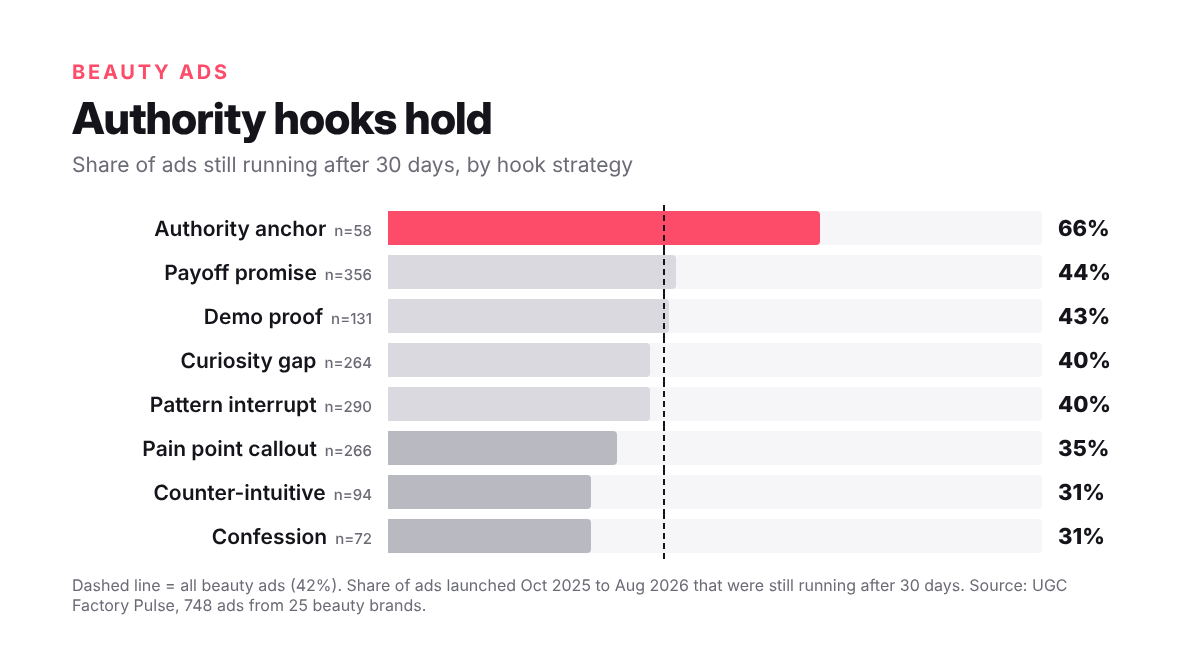
One hook stood clearly apart. Authority anchor hooks held at 66% across 58 ads from 13 brands: opening on a credential, a stat or the founder's reason for making the product.
Everything else clustered at or below average:
Payoff promise (44%) and demo proof (43%) ran about average. Showing the result works, but it isn't an edge on its own.
Curiosity gap and pattern interrupt (40% each) are two of the most-used hooks in beauty, and both ran slightly below average.
Pain point callout (35%), counter-intuitive (31%) and confession (31%) were the weakest. "I used to hate my skin" is everywhere, and most of it isn't surviving.
What to do with this: give viewers a reason to believe in the first two seconds. Who made it, what's in it, why it's different. Then show the result.
3. Captions: go big or go without
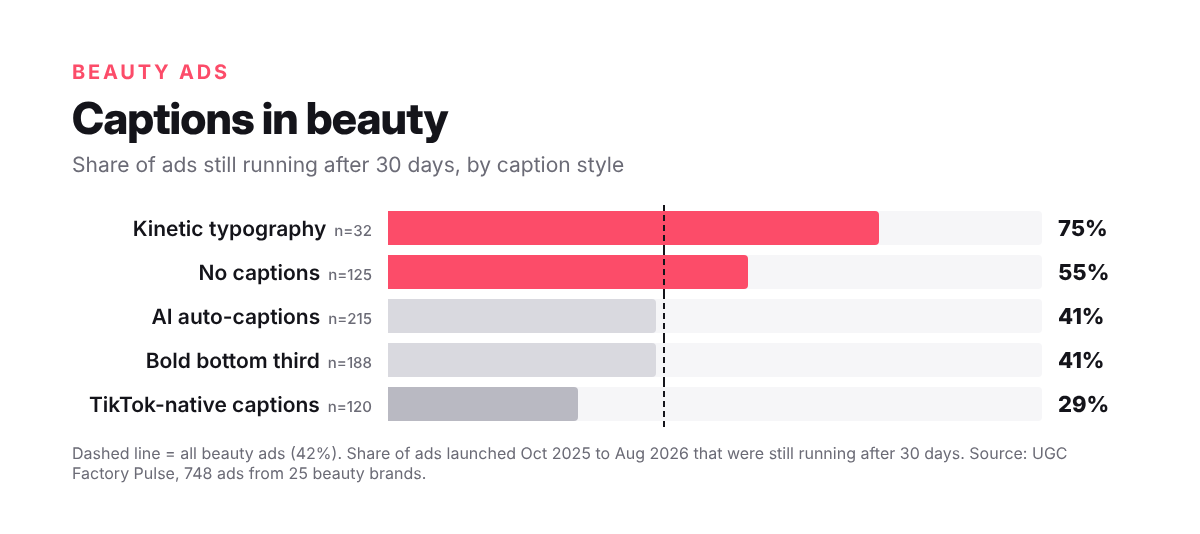
Caption style split beauty ads more than almost anything else:
Kinetic typography (75%), animated text that's part of the edit, did best. The sample is small (32 ads from 13 brands), so treat it as a strong signal, not a rule.
No captions at all (55%) also beat the average, and held at 62% with the biggest brand removed. Beauty is visual, and a clean frame lets the product and the result carry the ad.
AI auto-captions and bold bottom-third captions (41% each) ran average.
TikTok-native captions (29%) were the weakest style in the dataset.
This is the opposite of what we found in supplements, where native, lo-fi captions held best and kinetic typography lagged. Category matters. A caption style that wins in one vertical can sink in another.
What to do with this: test designed, animated text against a no-caption cut. Drop the default TikTok caption overlay.
4. Routines beat testimonials
Format told a similar story. Routine and stack ads held at 51% (37 ads): a creator or founder showing where the product fits in a morning or night routine, often next to other products. Testimonial ads held at just 32% (105 ads), well below average.
A straight "I tried this and loved it" review is the default beauty UGC format, and it's the one most likely to get switched off. Showing the product in use, in context, gives the viewer something to copy.
One more pattern: 729 of the 748 ads ran in 9:16. Vertical is no longer a choice in beauty.
Beauty ads that ran for months
A few long-running examples from the dataset, with links to the Meta Ad Library:
The Powder Shampoo (haircare), multi-product mashup, 210+ days: several products cut together around a travel use case. View ad
Blossom (beauty), spokesperson real-time review, 210+ days: a spokesperson trying the product live on camera. View ad
POV Beauty (makeup), founder routine, 140+ days: the founder walking through the product line as part of a routine. View ad
Keen Fragrances (body wash), skit with kinetic typography, 135+ days: a short comedic skit with animated on-screen text. View ad
Ads in the Meta Ad Library can be paused or removed by the brand at any time, so some links may stop working.
The beauty UGC playbook, in one list
Put the founder or the brand's own team on camera in every batch.
Open with a reason to believe: who made it, what's in it, why it's different.
Test designed kinetic text against a clean, no-caption cut. Skip default TikTok captions.
Show the product inside a routine instead of a straight testimonial.
Don't assume a credential carries the ad. Test professionals, but don't build around them.
Build everything for 9:16.
How we built this report
Pulse tracks the live Meta ads of top DTC brands. For this report we included ads from brands in our beauty categories that launched between October 1, 2025 and August 31, 2026 and had been analyzed for creative attributes (creator type, hook strategy, captions, format and more). "Still running after 30 days" is our proxy for performance, since spend and conversion data aren't public.
Because a few large brands run many ads, we re-ran every finding with the biggest contributing brand removed. Patterns that depended on one brand were left out of this report. Treat the results as directional patterns, not guarantees for any single brand.
Want this analysis for your own category and competitors? Book a strategy call and we'll show you what's working in your niche. See how we work with beauty brands.
About Dan Ragan
Founder of UGC Factory and expert in user-generated content marketing strategies. With over 10 years of experience in digital marketing, Dan helps brands leverage authentic content to drive engagement and conversions.