Supplement UGC Ads: What 1,648 Ads From 101 Brands Reveal
We analyzed 1,648 supplement ads from 101 DTC brands to see which creators, hooks, captions and formats keep running. The patterns, examples and playbook.
Table of Contents
Most "best supplement ads" lists are a handful of screenshots someone liked. This one is built on data.
We track the live Meta ads of the top DTC brands in our Pulse database. For this report we pulled every supplement ad launched between October 2025 and August 2026: 1,648 ads from 101 brands, across vitamins, protein, nootropics, greens, gut health, women's health and more. Each ad was broken down by format, who's on camera, hook type, captions and more.
Then we asked one question: which ads were still running 30 days after launch? Brands don't keep paying for ads that don't work, so staying live is the clearest public signal of a winner. Across all 1,648 ads, 60% made it past 30 days. Here's what separated the ones that did.
1. Founders, podcasts and experts outlast generic UGC
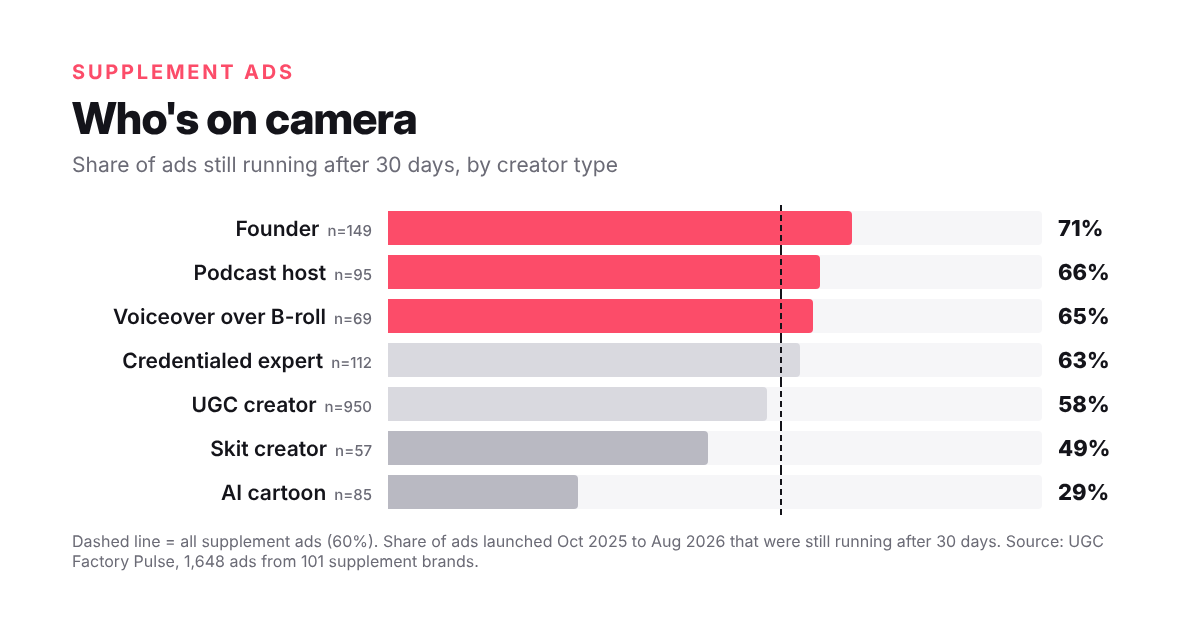
UGC creators made 58% of all the supplement ads in the dataset, and they ran close to average. The faces that beat the average had built-in credibility: founders (71%), podcast hosts (66%) and credentialed experts (63%).
The biggest loser was AI cartoon and avatar content: only 29% were still running after 30 days. Brands are clearly testing it, and most of it isn't surviving.
What to do with this: keep UGC creators as your volume engine, but add a founder story and an expert or podcast-style ad to every batch. In supplements, buyers want to know who's behind the formula.
2. Authority hooks beat pain-point hooks
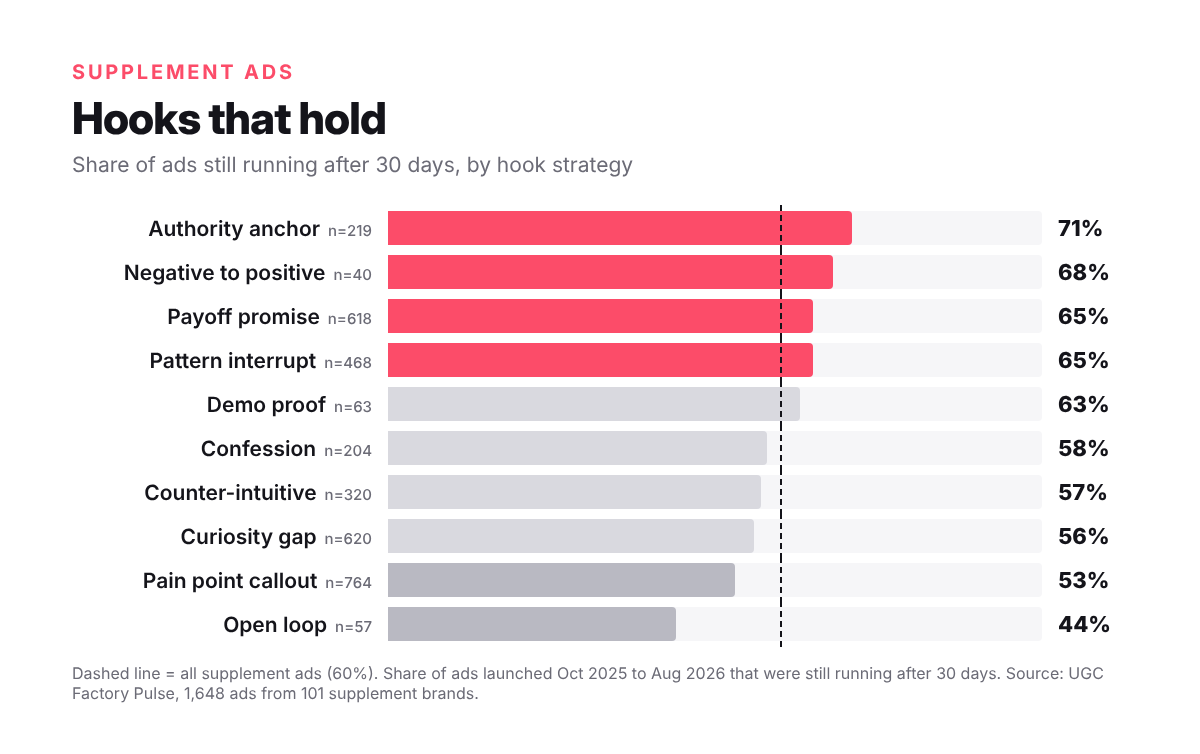
The most common hook in supplements is the pain-point callout ("Are you tired of...?"). It's also below average at 53%. The hooks that held were the ones that gave viewers a reason to believe:
Authority anchor (71%): opening on a credential, a stat or a founder's reason for making the product.
Negative to positive (68%): the before, then the after.
Payoff promise (65%) and pattern interrupt (65%): lead with the result, or with something visually unexpected.
Open loops ("You won't believe what happened...") did worst at 44%. Supplement buyers are skeptical, and teasing without substance doesn't hold them.
3. Polished captions underperform
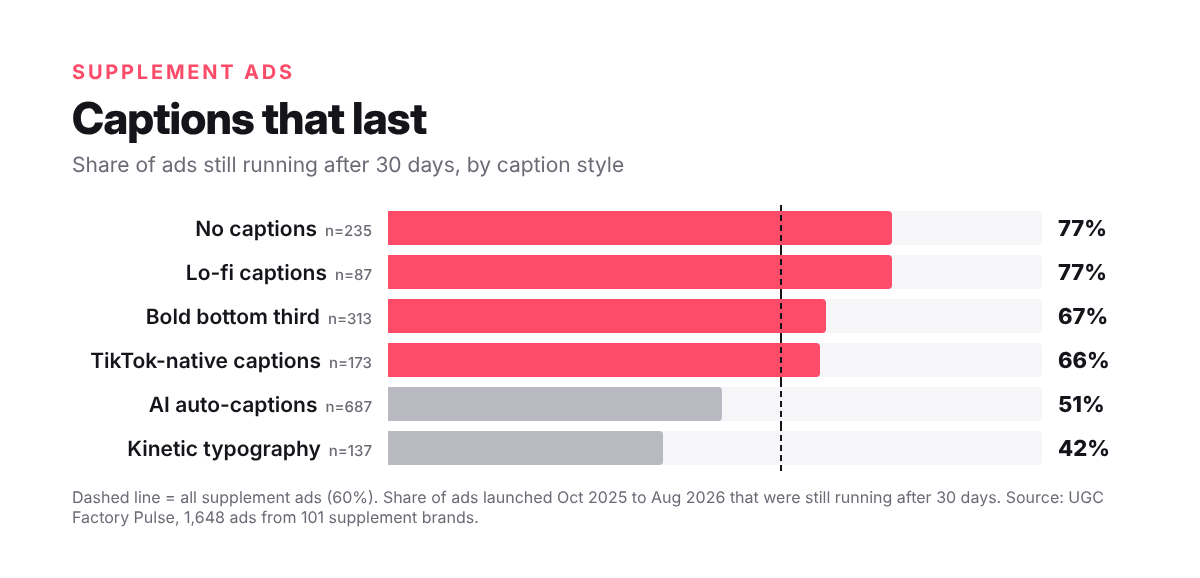
This was the most surprising result. The two most "produced" caption styles ran the worst: AI auto-captions (51%) and kinetic typography (42%). Ads with lo-fi captions or none at all ran at 77%.
Part of this is that silent, visual-first ads run long in general. Still, the direction is clear: when an ad looks like an ad, people scroll. Captions that look native to the platform keep the content feeling like content.
4. Put the product in the creator's hand
The opening frame matters too. Ads that opened on a creator talking while holding the product ran at 63%, against 49% for a talking head on a plain backdrop. Close-ups of hands holding or using the product (65 to 70%) and clean product hero shots (70%) also beat the average.
Animated explainers did worst at 34%. And almost everything was vertical: 96% of supplement ads were 9:16.
5. Testimonials are the most common format, not the strongest
Authentic testimonials were the most-used format (327 ads), but only 50% passed 30 days. Formats with more structure did better:
Lifestyle integration (the product inside a real routine): 66%
Routine or stack breakdowns: 66%
Podcast-style clips: 65%
Founder's angle: 65%
B-roll with text overlay: 72%
Testimonials aren't dead. They work best when the creator has a specific story and context, not a generic "I love this product." We cover how to brief that in why we test statics before video.
Examples worth studying
A few long-running supplement ads from the dataset, with links to the public Meta Ad Library so you can watch them. Days running are as of our last check in late September 2026.
Zest (energy), testimonial, 250+ days: "Are you tired of needing one of these every morning?" A gym creator holds up an energy drink, then swaps it for a time-release caffeine capsule. View ad
Perelel (women's health), testimonial, 220+ days: a direct-to-camera story about perimenopause symptoms and daily vitamin packs. View ad
Rho Nutrition (vitamins), founder's angle, 220+ days: the co-founder explains the technology behind the product. View ad
Energybits (greens), educational, 200+ days: "One of the biggest myths is that spirulina is just another plant-based supplement." View ad
Needed (women's health), podcast, 175+ days: "95% of women in the US are nutritionally depleted." An authority hook delivered at a podcast mic. View ad
DryWater (energy), lifestyle integration, 150+ days: no voiceover, just a morning routine with the product. View ad
Sports Research (vitamins), routine breakdown, 115+ days: "If you have not nailed down your foundational supplement routine yet..." View ad
Nutricost (creatine), skit, 130+ days: a humor skit built around a giant mascot of the product. View ad
Ads in the Meta Ad Library can be paused or removed by the brand at any time, so some links may stop working.
The supplement UGC playbook, in one list
Mix in credibility: a founder ad and an expert or podcast-style ad in every batch.
Open with a reason to believe, not just a pain point.
Keep captions native and simple. Skip heavy motion text.
Put the product in the creator's hand in the first frame.
Use structured formats (routines, stacks, lifestyle) over generic testimonials.
Treat AI avatars as a test, not a strategy.
How we built this report
Pulse tracks the live Meta ads of top DTC brands. For this report we included ads from brands in our supplement categories that launched between October 1, 2025 and August 31, 2026 and had been analyzed for creative attributes (format, creator type, hook strategy, captions, opening frame and more). "Still running after 30 days" is our proxy for performance, since spend and conversion data aren't public. Small groups (under 40 ads) were left out of the charts. Treat the results as directional patterns, not guarantees for any single brand.
Want this analysis for your own category and competitors? Book a strategy call and we'll show you what's working in your niche. See how we've done it for supplement brands.
About Dan Ragan
Founder of UGC Factory and expert in user-generated content marketing strategies. With over 10 years of experience in digital marketing, Dan helps brands leverage authentic content to drive engagement and conversions.