Performance Creator Pay Is Moving to CPM
Paid reach got 14% more expensive in a year. The brands winning now pay creators for views first and sales second. Here's why, from a founder who's bullish on performance.
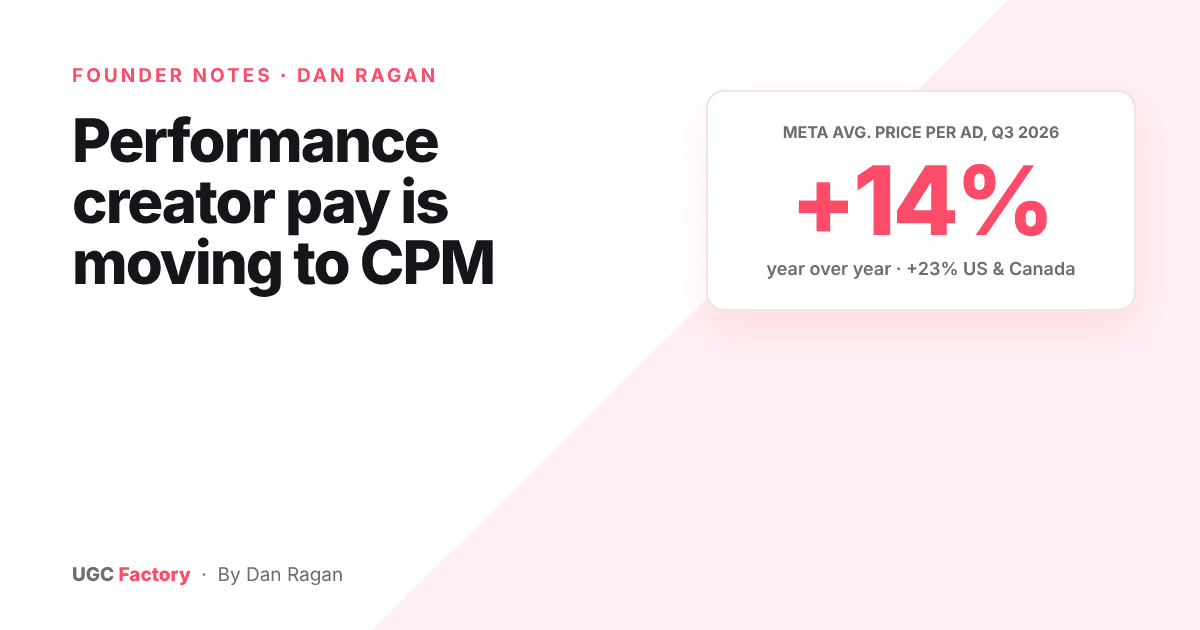
Table of Contents
I'm bullish on performance pay for creators. I'm also convinced the unit is changing. For the last few years "performance" meant paying creators a cut of sales or ad spend. In 2026 the sharpest operators I know pay for views first, on a CPM, and treat sales as a bonus. Most of them are quiet about it.
Why it's shifting: paid reach got expensive
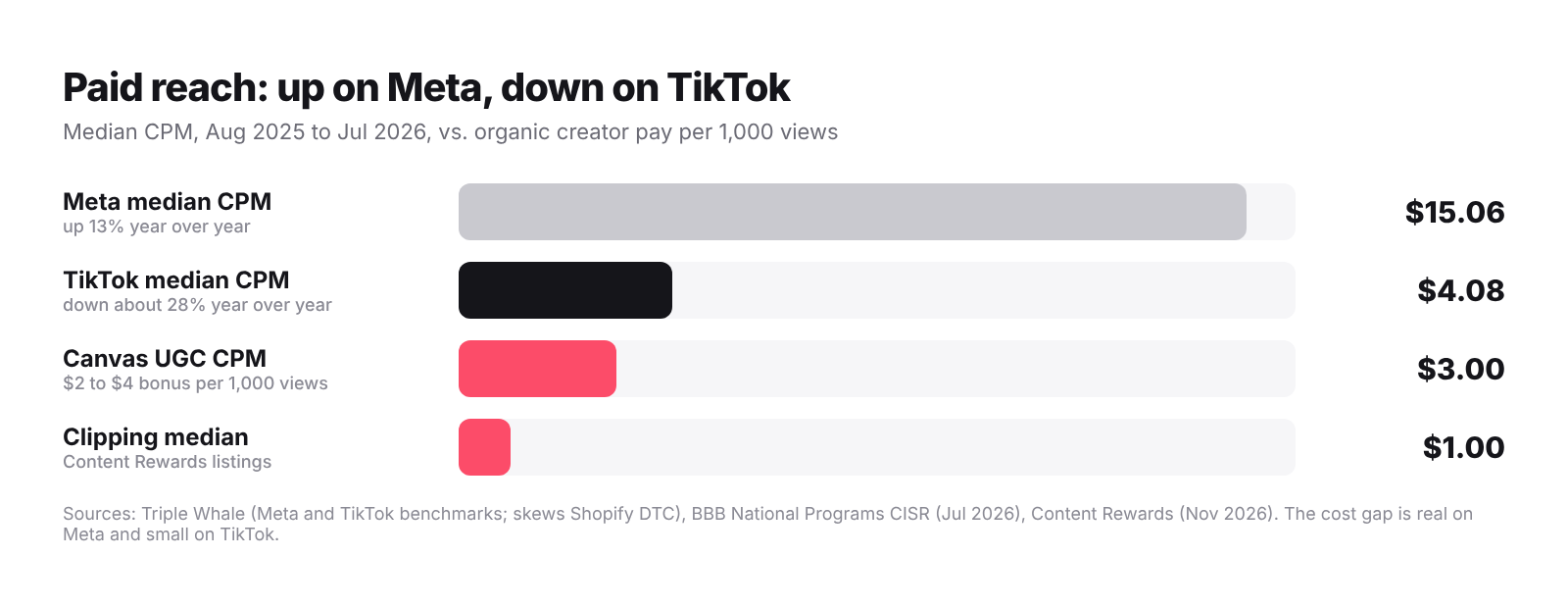
Meta's average price per ad rose 14% year over year in Q3 2026 while impressions grew 10% (Meta's Q3 2026 results). In the US and Canada, price per ad was up 23%, according to Single Grain's read of Meta's earnings materials. Triple Whale's median Meta CPM across its brands hit $15.06 for the year to July 2026, up 13%.
TikTok is the exception. Triple Whale's TikTok benchmarks show median TikTok CPM fell about 28% to $4.08 over the same period, so the cost argument is strongest on Meta.
That increase came out of margin. Plenty of products that worked on paid two years ago don't anymore. Commission programs on top of paid ads still work, but only for brands whose unit economics survive the new CPMs.
The social graph became an interest graph
Feeds now serve content to people based on what they're into, not who they follow. That's why we've moved past "influencer" as the unit. A brand doesn't need someone with a big audience. It needs lots of specific videos for specific problems, and the algorithm decides who sees them. Pay a premium for an influencer and you pay a premium per impression. Pay creators per view on content built for niches, and you buy reach closer to cost.
The best-known example: Bloom
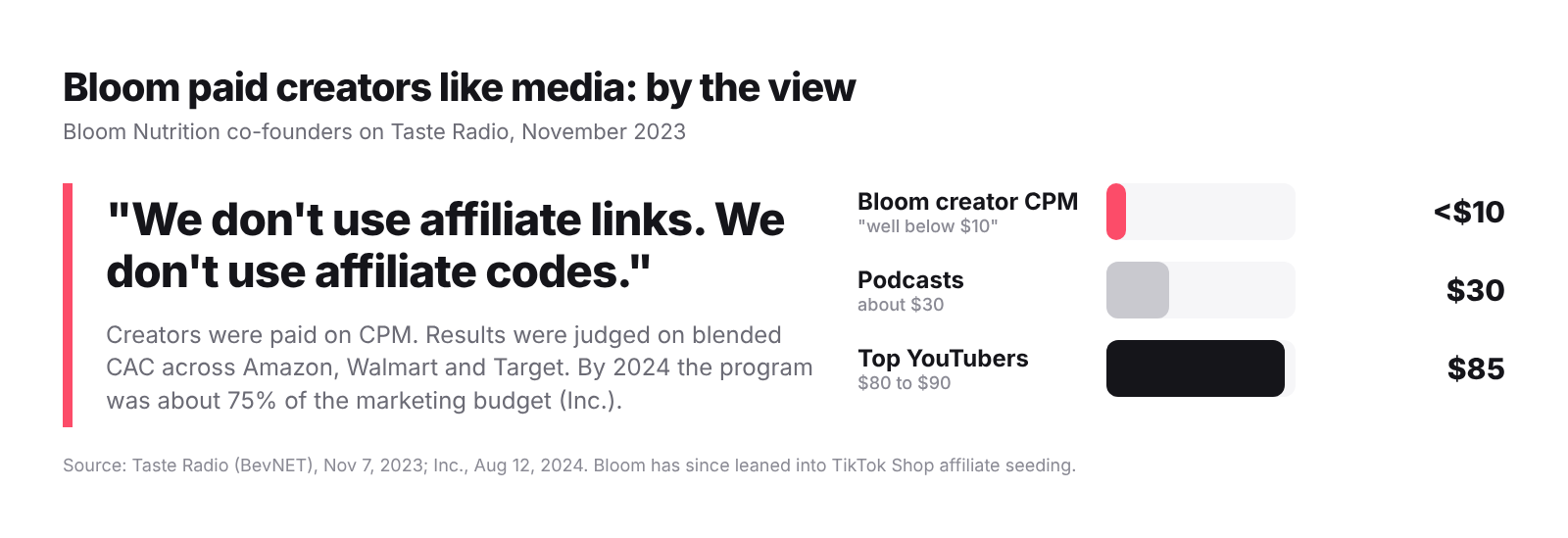
Bloom Nutrition built a brand doing $500M a year (Forbes) partly by buying creator video like media. In 2023 its co-founders told Taste Radio: "We don't use affiliate links. We don't use affiliate codes." Creators were paid on CPM, "well below $10," against about $30 for podcasts and $80 to $90 for top YouTubers. By 2024 the program was about 75% of the marketing budget (Inc.). Bloom has since leaned into TikTok Shop seeding, but the principle held: pay for attention at a price you control.
What CPM-first pay looks like
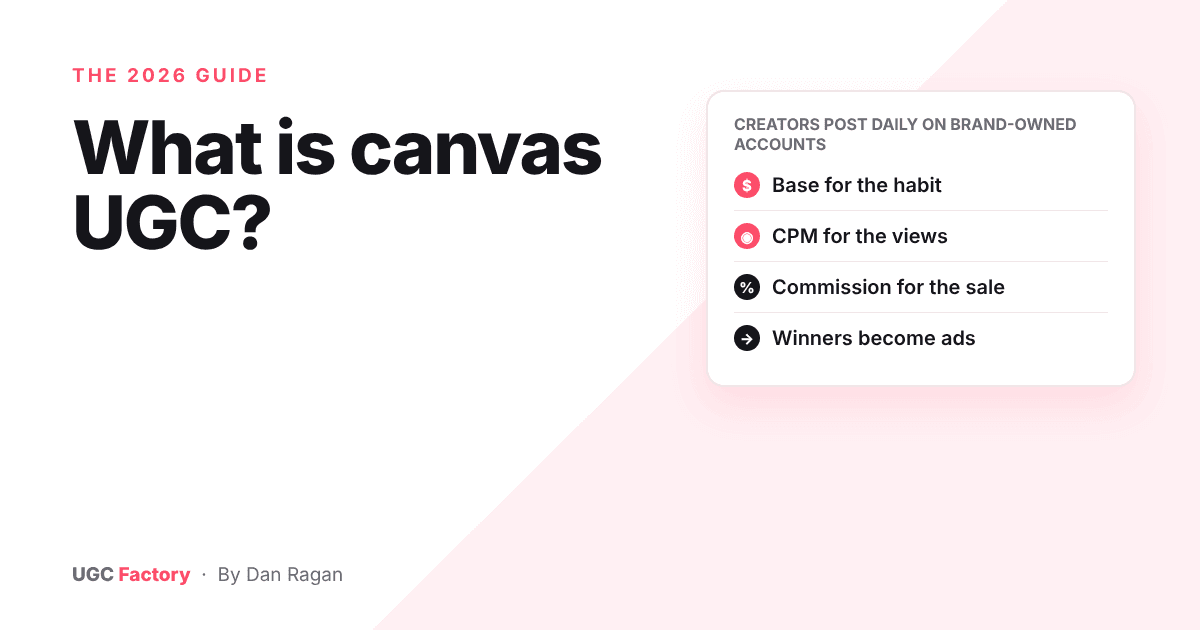
Base for the posting habit.
CPM for reach on organic accounts, brand-owned or the creator's.
Boost bonus when a post earns paid budget.
Commission on sales once the post runs as an ad, through a platform like Trybe.
This is the canvas UGC model, and it stacks with commission platforms instead of replacing them. Organic CPM finds winners. Paid commission scales them.
Who loses in this shift
Media buyers whose job is mostly button-pushing. Agencies selling a fixed batch of polished ads. Creators who make one or two videos per brand and wait. The new edge is volume and feedback speed: make far more content, read the signal fast, and feed what works back into the next round.
The honest caveats
A view isn't a click and isn't a sale. CPM programs need a path from organic winners to paid scale, or they're just expensive reach.
View counts can be gamed. Log every post, cap per-video views, and watch for bot patterns.
Disclosure still applies. See our disclosure guide.
Read next: arbitraging impressions and organic-first ad testing.
FAQ
Why are brands paying creators on CPM?
Paid reach costs more every year, with Meta's average price per ad up 14% year over year in Q3 2026. Paying creators per view on organic content buys reach for less and finds winners before ad spend.
Is CPM pay better than commission?
They do different jobs. CPM pays for reach and testing volume. Commission pays for sales once content runs as ads. The strongest programs use both.
How much did Meta ad prices rise in 2026?
Meta reported average price per ad up 14% year over year in Q3 2026, with impressions up 10%. Single Grain reported 23% for the US and Canada.
About Dan Ragan
Dan Ragan has spent his career going where it's hard to scale. He ran live-streaming activations for brands like Bose, Marriott and Warner Bros, then founded UGC Factory, which has made creator ads for about 1,000 DTC brands and now runs on an AI back end with two full-time employees. His newest work takes the creator commission model off the screen: paid ambassadors running in-person demos, filmed on Meta glasses and paid on the sales they start. He's proving it on BASSCRAFT, the haptic bass seat cushion he co-founded, and building it into POV Factory for other brands. He lives in Austin and also owns Soundhouse ATX.