Why We Test Static Ads Before We Shoot a Single Video
Video is the most expensive way to learn. How we use static ads to test messages and micro-personas first, then put video budget behind proven angles.
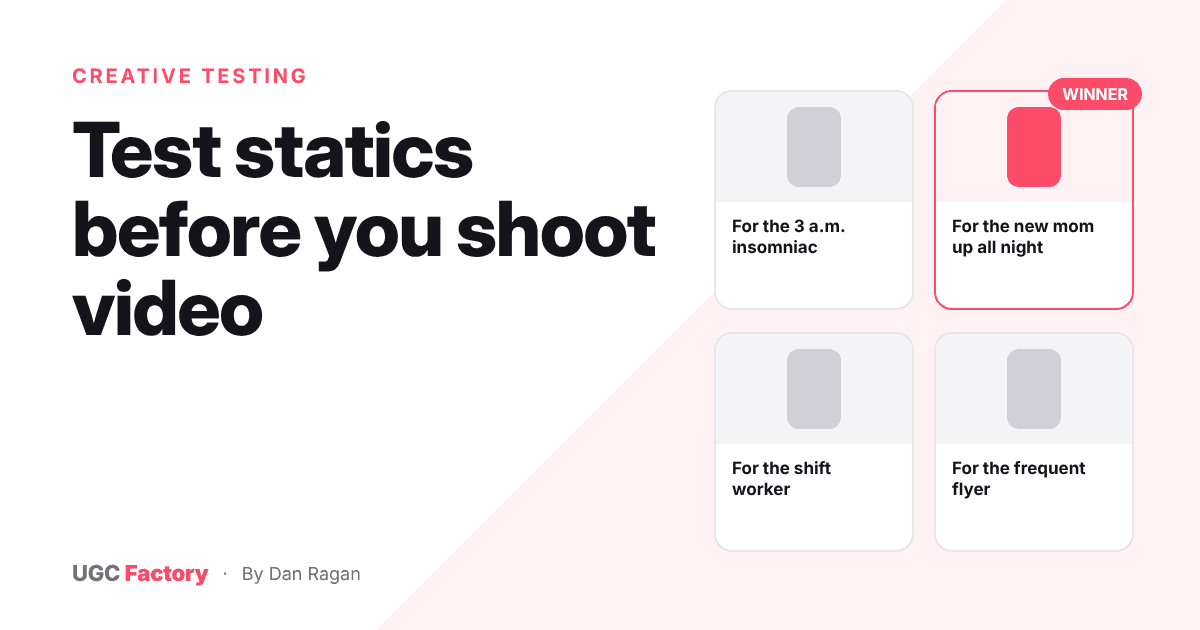
Table of Contents
Video is the most expensive way to learn something about your customer.
A round of UGC video takes weeks: casting, shipping product, filming, editing, revisions. If the message underneath it is wrong, you find out a month and a budget later. That's why, before we shoot anything new for a brand, we test the message with static ads first.
Statics are faster and cheaper, and they answer the question video can't afford to get wrong: which message, for which customer, actually moves people?
Why test with statics first
Think of statics as the lab and video as the factory.
Speed. A batch of statics can be designed and live within one to two weeks. A video round usually takes three weeks or more.
Cost. You can test dozens of messages in static for a fraction of what a single video round costs.
Clean reads. A static has fewer moving parts than a video. No creator charisma, pacing or music skews the result, so you learn more about the message itself.
Once a message wins in static, every video you make after that starts from a proven angle instead of a guess.
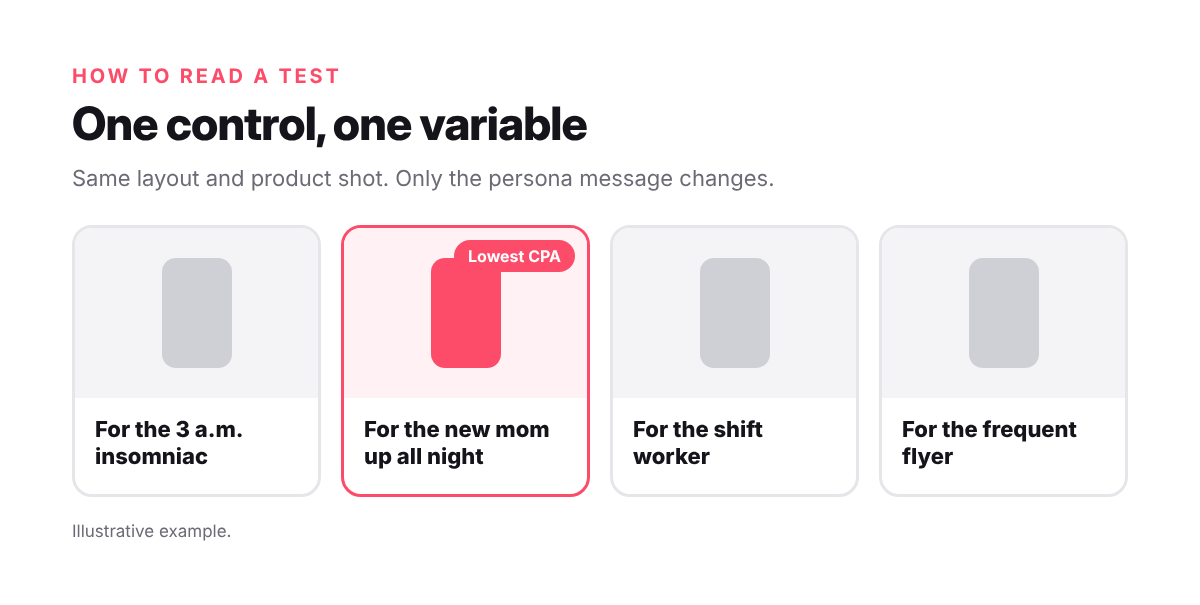
Remember science class: one control, one variable
The most common mistake in creative testing is changing everything at once. New image, new headline, new offer, new audience. When something wins, nobody knows why.
We lock one visual format across the whole test and change only the message and the persona it speaks to. If the layout, colors and product shot stay constant, the difference in performance comes from the message. That's the only way the result tells you something you can reuse.
Test micro-personas, not generic benefits
"Better sleep" isn't a message. "For the new mom who's up at 3 a.m. and can't fall back asleep" is.
Each static in a test should be pinned to one narrow customer and one specific moment in their life. It won't speak to everyone, and that's the point. Specific messages either hit hard or miss clearly, and both results are useful. Generic messages perform in the middle and teach you nothing.
Our static-first workflow
Here's the process we run, step by step.
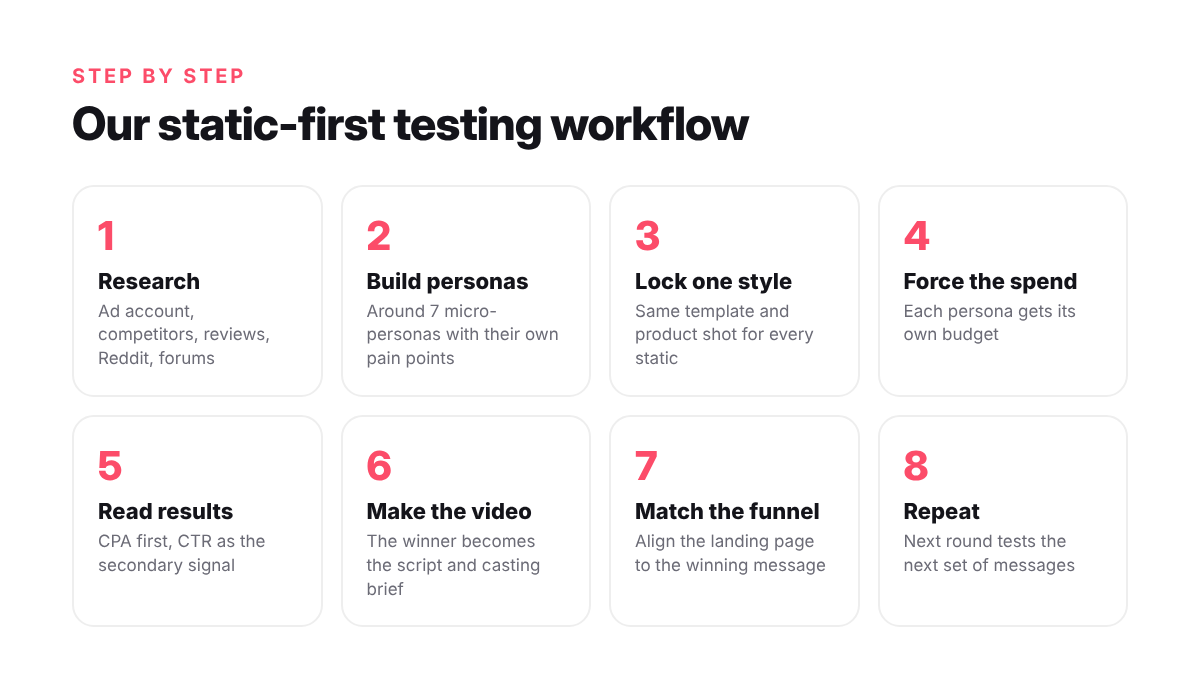
Research. We start with the brand's own ad account, then direct competitors, then broader DTC patterns. On top of that: customer reviews, Reddit threads, forums and onboarding answers, anywhere real customers describe the problem in their own words.
Build personas. From that research we usually land on around seven distinct micro-personas, each with its own pain point, trigger moment and language.
Design statics in one locked style. Same template, same product shot. Only the persona message changes.
Force the spend. Each persona gets its own budget so every message gets a fair read, instead of letting the algorithm pile everything onto one early leader.
Read the results. CPA is the primary signal. Click-through rate is a useful secondary one, especially when volume is still low.
Turn the winner into video. The winning persona becomes the basis for video scripts and, just as important, the casting brief.
Match the funnel. Where it makes sense, the landing page gets aligned to the winning message too.
AI is the testing tool, creators are the scaling tool
AI is very good at the testing phase. It's quick and cheap to generate many static variations, so you can explore more messages per dollar. Some AI statics even scale on their own.
But for video, we lean on real people. Once a persona wins, we look for creators who have actually lived that experience instead of handing an actor a script. A creator who really was the exhausted new mom will tell that story better than any script we could write. For testimonial-style ads we brief with talking points, not word-for-word scripts, so the delivery stays natural.
Don't break the message at the click
If a static wins with a very specific message and the click lands on a generic product page, you lose much of what you learned. The person who clicked because of a 3 a.m. insomnia message should land somewhere that keeps talking about the 3 a.m. problem.
Consistency from ad to landing page is one of the most underrated levers in DTC. The static test hands you exactly what that page should say.
Practical tips for running static tests
Name files with a strict convention (persona, angle, format, version) so results drop straight into a pivot table in Ads Manager.
Your own media buyer can run it. A creative partner mainly needs access to see the data and plan the next round.
Run statics alongside video, not instead of it. Statics feed the video pipeline. They don't replace it.
Give winners real budget. A message that wins in a small test still has to prove it can carry spend.
When static-first isn't the right call
Some products only make sense in motion: a demo-heavy gadget, a texture or transformation, an app walkthrough. For those, we still test messages cheaply, but the test asset might be a short, simple video instead of a static. The principle stays the same: learn cheaply first, then invest in the expensive asset.
The bottom line
Testing statics first doesn't replace great video. It makes great video more likely. You spend days and a small budget learning what your customer responds to, then put your real production budget behind a message you already know works.
Want us to map out a static test for your brand? Book a strategy call. You can also see how this plays out across categories like supplements and health and wellness.
About Dan Ragan
Founder of UGC Factory and expert in user-generated content marketing strategies. With over 10 years of experience in digital marketing, Dan helps brands leverage authentic content to drive engagement and conversions.