Cost Per Result (CPR) Analysis 2025: UGC Guide
Master 2025 CPR with formulas, US FB/TikTok benchmarks, and UGC tactics. Cut costs, boost ROI, and optimize ad spend now with proven, actionable steps.
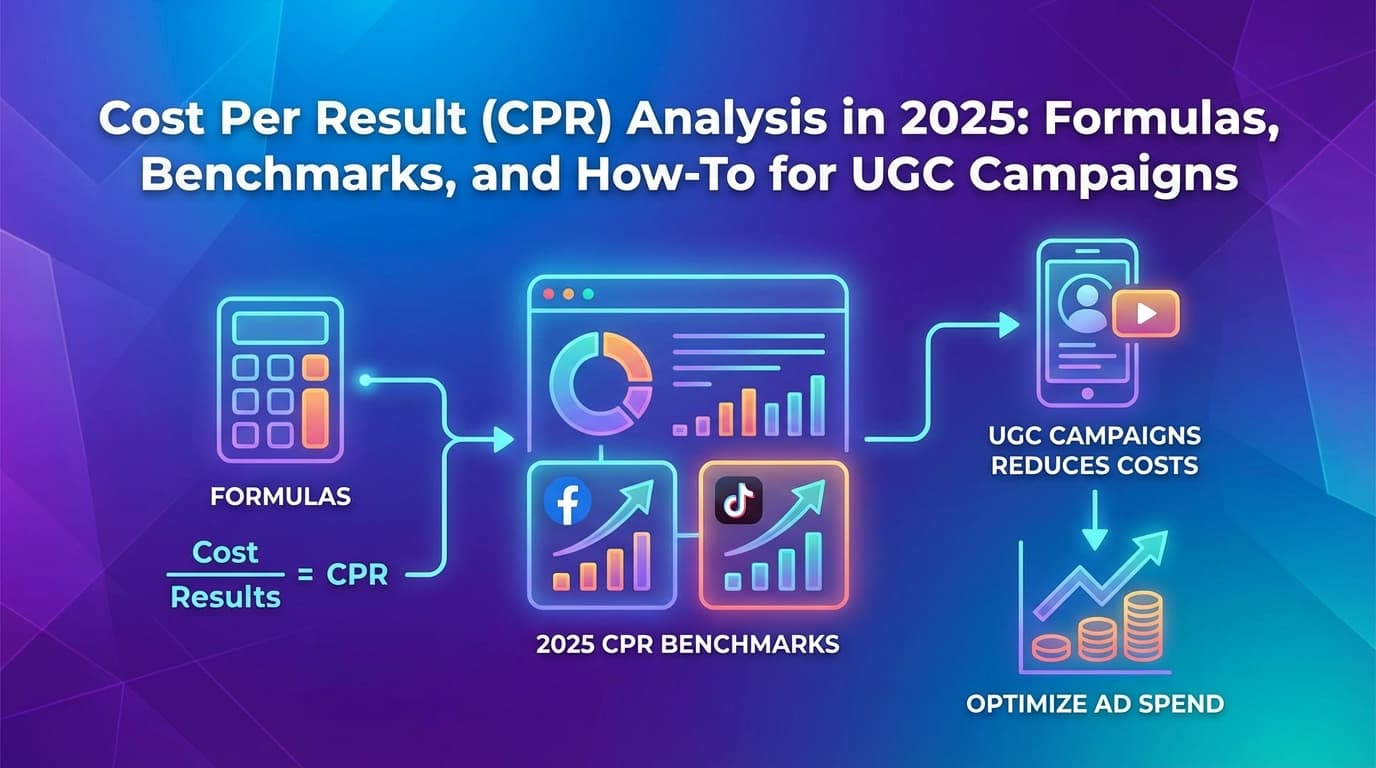
Table of Contents
Introduction: Why Cost Per Result Matters in 2025
In 2025, digital marketing has moved beyond vanity metrics. With ad spend projected to top $200 billion across social platforms and CPMs (Cost Per Mille) rising due to inflation and increased competition, efficiency is the only metric that truly matters. For US marketers and Direct-to-Consumer (DTC) brands, Cost Per Result (CPR) has become the North Star metric.
Unlike broad metrics like impressions, CPR tells you exactly how much you pay for the outcome that drives your business forward - whether that’s a purchase, a lead, or an app install. But here is the reality check: traditional ad creative is failing to keep CPR low. The solution dominating 2025 strategies? User-Generated Content (UGC).
This guide will equip you with the formulas, channel-specific benchmarks, and UGC optimization tactics you need to slash your CPR and maximize ROI in the current landscape.
What Is Cost Per Result? CPR Defined for Marketers
Cost Per Result (CPR) is a metric that measures the actual cost incurred to achieve a specific campaign objective. Unlike Cost Per Click (CPC), which only measures intent, CPR measures success.
In 2025, the definition of "Result" is flexible but critical. It changes based on your campaign settings in platforms like Meta Ads Manager or TikTok Ads:
E-commerce: Result = Purchase (CPA)
SaaS/B2B: Result = Lead Form Submission (CPL)
App Growth: Result = App Install (CPI)
Branding: Result = 1,000 Impressions (CPM) or Video View
The Core Formula:
CPR = Total Ad Spend / Total Number of Results
How to Calculate CPR: Formulas and Walkthroughs
Let’s look at a practical scenario for a US-based skincare brand running a UGC campaign on TikTok.
Scenario: You spend $5,000 on a campaign. You track two different "results": Link Clicks and Purchases.
Total Spend: $5,000
Total Link Clicks: 2,500
Total Purchases: 125
Calculation A (Cost Per Click Result):
$5,000 / 2,500 = $2.00 per Click
Calculation B (Cost Per Purchase Result):
$5,000 / 125 = $40.00 per Purchase
In this context, your CPR for the business goal (revenue) is $40. If your product profit margin is $50, you are profitable. If it's $30, you are losing money. This simple calculation is the bedrock of performance marketing.
Benchmarks: What Is a Good CPR in 2025 (US Data)
Knowing your numbers is half the battle; knowing where you stand against the competition is the other half. Below are the estimated benchmarks for 2025 based on late 2024 performance data and 2025 inflation projections.
2025 US Advertising Benchmarks by Channel
Channel | Avg. Cost Per Result (CPA/Action) | Avg. CPC | UGC Impact (Est. CPR Reduction) | Strategic Best Use |
|---|---|---|---|---|
$18 - $55 (Lead/Purchase) | $0.70 - $1.92 | -35% to -50% | High-volume scale for Gen X & Millennials. | |
$25 - $65 (Action) | $1.80 - $3.35 | -50% (via Reels) | Visual storytelling and D2C brand building. | |
TikTok | $15 - $45 (Purchase) | $0.50 - $2.00 | -60% (Native UGC) | Gen Z targeting & viral product launches. |
$55 - $130 (Lead) | $5.00 - $8.00 | -20% (Employee UGC) | High-ticket B2B SaaS & professional services. | |
Google Ads | $45 - $80 (CPA) | $2.50 - $4.00 | N/A (Search focus) | High-intent capture (Bottom of Funnel). |
Note: "UGC Impact" refers to the potential reduction in CPR when switching from stock/studio creative to high-performing User-Generated Content.
Channel-Specific CPR: Social, Influencer, and UGC
Not all channels behave the same way. Understanding the nuance of CPR on each platform is vital for 2025 strategy.
1. Social Ads (Meta & TikTok)
On social platforms, creative fatigue is the #1 killer of CPR. When an audience sees the same polished ad three times, costs skyrocket. UGC combats this by blending in with organic feeds. Data shows that ads featuring UGC can see a 50% lower Cost Per Click (CPC) and Cost Per Acquisition (CPA) compared to standard brand ads.
2. Influencer Marketing
Traditionally, influencer marketing was measured by engagement. In 2025, it's measured by CPR (Conversions). However, influencer CPR is often higher than paid ads initially because you pay a premium for the creator's trust. The "hack" here is whitelisting - running paid ads through the influencer's handle - which typically lowers CPR by 20-30% compared to brand-handle ads.
Step-by-Step: Analyzing CPR for UGC Campaigns
Optimizing a UGC campaign requires a specific analytical approach. Follow this 4-step framework:
Isolate the Variable: Run an A/B test with the exact same audience and budget. Use one "Studio Polished" image vs. one "UGC Video" (e.g., an unboxing or testimonial).
Measure "Hook Rate": Before looking at the final CPR, look at the 3-second video view rate. If the UGC hook rate is low, your creative isn't stopping the scroll, and your CPR will be high.
Calculate Creative CPR: Break down your CPR by specific creative asset. You will likely find that 20% of your UGC videos are driving 80% of your results at a low cost.
Scale the Winners: Take the UGC asset with the lowest CPR and move it to a "Scaling Campaign" with a higher budget.
Common Mistakes and How to Avoid Them
Mistaking CPC for CPR: Getting cheap clicks ($0.50) doesn't help if those visitors don't buy. Always optimize for the final result (Purchase/Lead).
Ignoring Ad Fatigue: If your CPR creeps up week-over-week, your audience is bored. Refresh your UGC creative every 1-2 weeks.
Broad Targeting in 2025: AI algorithms (like Meta's Advantage+) are smart, but they need guidance. Don't go 100% broad without testing interest stacks first.
Optimizing Your CPR: Strategies and Tools
To aggressively lower your CPR in 2025, you need to leverage technology and psychology.
Leverage AI Scripting: Use AI tools to generate multiple hook variations for your creators. Testing 5 different hooks on the same video body can drastically change performance.
The "Authenticity" Gap: Consumers in 2025 are skeptical. Content that looks too produced raises ad blindness. Raw, shot-on-iPhone content often outperforms high-production value ads because it feels trustworthy.
UGC Factory Approach: Instead of relying on one-off influencer deals, build a "factory" of content. Source 10-20 pieces of raw UGC monthly to constantly feed your ad account and find the CPR winners.
Expert Q&A: Advice for US Marketers
We analyzed insights from top industry voices and data reports to bring you this 2025 perspective.
Q: Is UGC still effective in 2025?
A: Absolutely. In fact, it's more critical. Industry data from 2024-2025 consistently shows that UGC-based ads achieve up to 4x higher click-through rates and a significantly lower CPA than standard ads. As ad platforms become more automated, the creative becomes the primary lever for targeting. Better creative = lower CPR.
Q: What is the biggest threat to CPR in 2025?
A: Inflation and signal loss. With privacy changes, tracking is harder. This means platforms often report fewer results than actual, making your CPR look artificially high. Using third-party tracking tools or server-side tracking (CAPI) is essential to see your real CPR.
Glossary: CPR and Related Metric Terms
CPR (Cost Per Result): Total Spend / Total Results.
CPC (Cost Per Click): Cost for a single click on an ad.
CPM (Cost Per Mille): Cost for 1,000 impressions.
CTR (Click-Through Rate): Percentage of people who click after seeing the ad.
ROAS (Return on Ad Spend): Revenue / Ad Spend. The inverse of CPR for e-commerce.
CPA (Cost Per Action): Often used interchangeably with CPR, usually referring to bottom-of-funnel actions like purchases.
Conclusion and Key Takeaways
Mastering Cost Per Result (CPR) Analysis in 2025 isn't just about math - it's about agility. The winners in the US market will be those who combine rigorous data analysis with the high-performing, authentic nature of User-Generated Content.
Key Takeaways:
Define Your Result: Ensure you are optimizing for business outcomes (Sales/Leads), not vanity metrics (Likes).
Benchmark Continuously: Use the 2025 table above to gauge if your Meta CPA of $40 is good or bad for your industry.
Embrace UGC: It is the single most effective tool for lowering CPR in a high-cost advertising environment.
Test Aggressively: Creative fatigue is real. A "UGC Factory" mindset of constant testing is the only way to keep CPR stable at scale.
About Dan Ragan
Founder of UGC Factory and expert in user-generated content marketing strategies. With over 10 years of experience in digital marketing, Dan helps brands leverage authentic content to drive engagement and conversions.