How to Pay Canvas UGC Creators: Base, CPM and Commission
Base for the habit, CPM for the reach, commission for the sale. How to set each number, cap the downside, and keep good creators posting.
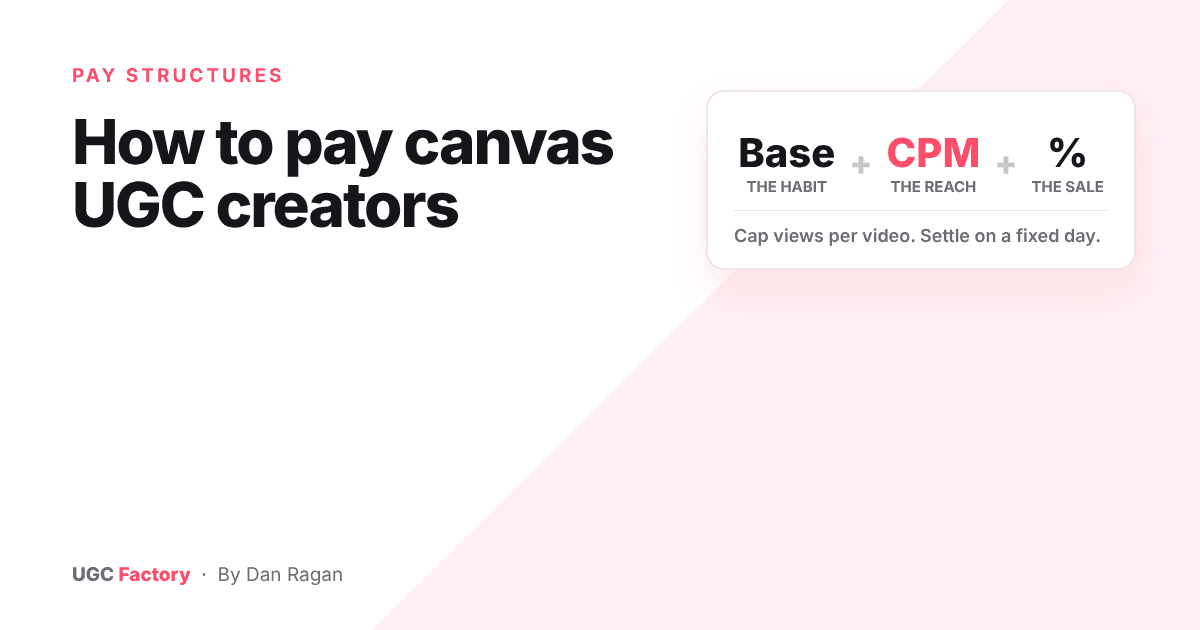
Table of Contents
Canvas UGC creators are usually paid in three parts: a base that pays for the posting habit, a CPM that pays for reach, and an optional commission that pays for sales. Get the mix wrong and you either overpay for posts nobody sees or lose your best creators to programs that pay them fairly.
The three parts, and what each one buys
Base (the habit). A per-video fee or monthly retainer for hitting the quota. Published ranges run about $10 to $20 per video (ReelPilot). Without a base, creators stop posting the moment a week goes flat, and volume is the whole game.
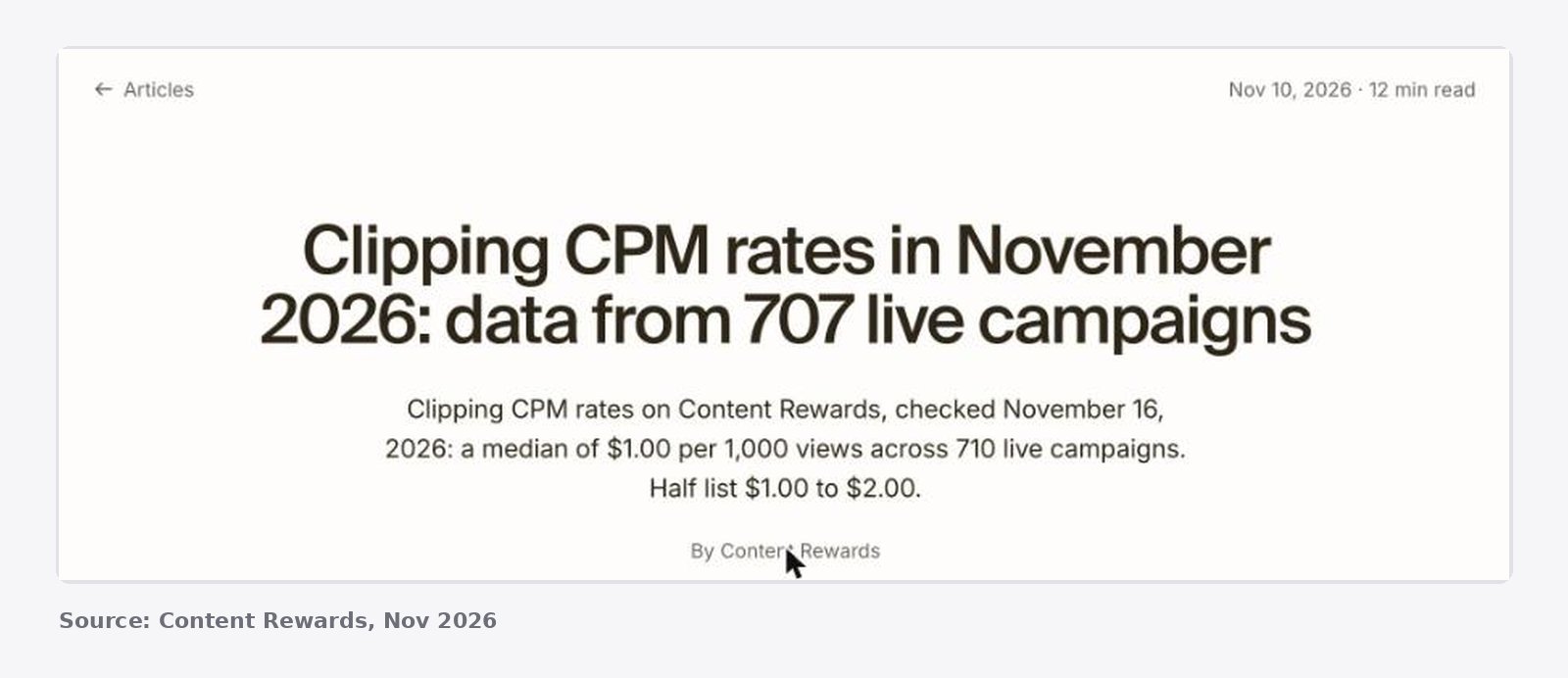
CPM (the reach). A rate per 1,000 views, commonly $2 to $6 (ReelPilot, Plug Pro). Clipping-heavy marketplaces list around $1 (Content Rewards). Pay it in arrears once views settle.
Real programs. StudyFetch pays $50 to $2,500 per video plus $100 per 100,000 views (GTM Sauce). Rizz's founder posted on X pay of about $1 to $2 per 1,000 views with a cap per post. Founder-reported figures.
Commission (the sale). A percentage of attributed revenue, through a code, link or a platform like Trybe when posts become ads. Optional, and only fair if attribution is reliable.
A worked example
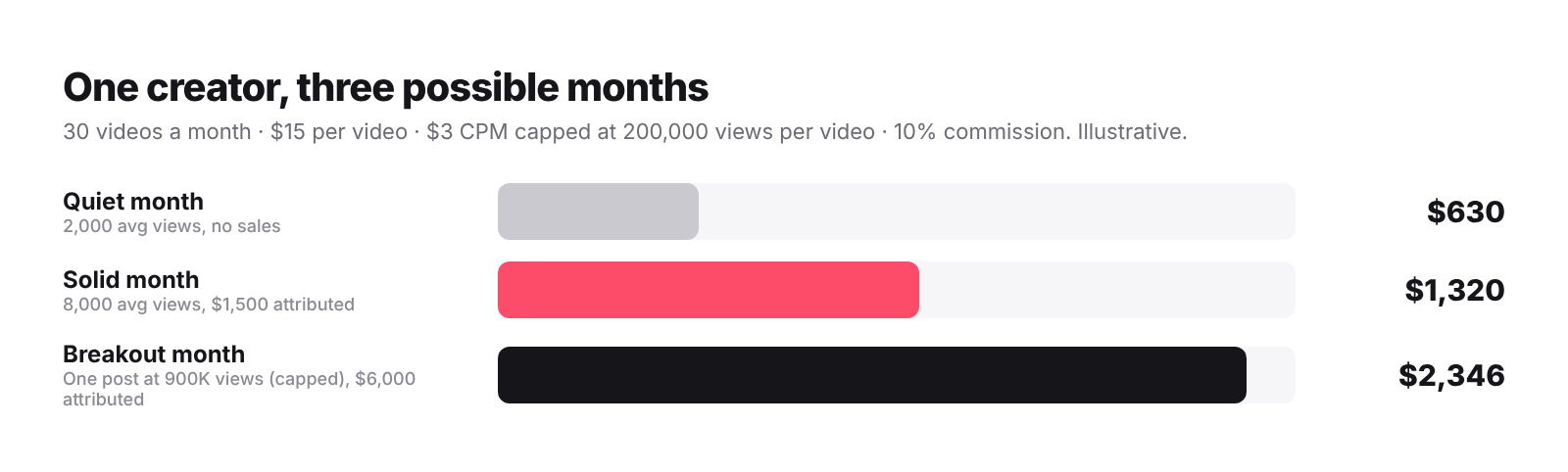
Thirty videos a month, $15 base per video, $3 CPM, 10% commission on attributed sales:
Quiet month (2,000 average views, no sales): $450 base + $180 CPM = $630.
Solid month (8,000 average views, $1,500 attributed): $450 + $720 + $150 = $1,320.
One video breaks out (one post at 900,000 views, the rest at 8,000, $6,000 attributed): the per-video cap holds the viral post to 200,000 paid views, so 432,000 paid views in total. $450 + $1,296 + $600 = $2,346.
The brand's cost per 1,000 views in the solid month is about $5.50 all-in. Meta's median CPM was $15.06 for the year to July 2026 (Triple Whale).
Caps and floors that protect both sides
Per-video view cap. Keeps one viral hit from eating the month's budget. 100,000 to 250,000 views is common.
Minimum views before CPM pays. A small floor, like 1,000 views, discourages spam posting.
Boost bonus. Pay a flat bonus when a post gets promoted to a Spark Ad or partnership ad. It's the clearest signal the creator found a winner.
Settlement window. Count views at a fixed point, like 14 days after posting, so nobody argues about late views.
Mistakes we see
CPM only, no base. Creators front-load effort, hit a slow week and vanish. The account goes cold.
Commission only. On organic accounts, most purchases can't be traced back to a single post. Creators feel underpaid even when they're driving sales.
No view log. Pay disputes start the day you can't show which video got which views. Track links and counts per post from day one.
Same rate for everyone forever. Raise CPM for creators whose posts keep getting boosted. Rate is the cheapest retention tool you have.
How this compares with commission ad programs
On Trybe-style programs, creators are paid on sales or ad spend after the brand runs their content as ads. That works when the brand has budget behind it. Canvas pay works before any ad spend, which is why it's becoming the front end of the funnel. Our guide to paying UGC creators covers the paid-side models.
Read next: why performance creator pay is moving to CPM.
FAQ
What's a fair CPM for canvas UGC creators?
About $2 to $6 per 1,000 views in late 2026 published ranges, depending on niche and track record. Clipping campaigns list closer to $1.
Should canvas creators get a base?
Yes. A base of roughly $10 to $20 per video keeps the posting habit alive through slow weeks, and volume drives results.
How do you stop one viral video from blowing the budget?
Cap paid views per video, for example at 200,000, and settle views at a fixed point after posting.
Should canvas creators get commission?
Only when sales can be attributed reliably, through codes, links or posts that become ads on a platform that tracks sales.
About Dan Ragan
Dan Ragan has spent his career going where it's hard to scale. He ran live-streaming activations for brands like Bose, Marriott and Warner Bros, then founded UGC Factory, which has made creator ads for about 1,000 DTC brands and now runs on an AI back end with two full-time employees. His newest work takes the creator commission model off the screen: paid ambassadors running in-person demos, filmed on Meta glasses and paid on the sales they start. He's proving it on BASSCRAFT, the haptic bass seat cushion he co-founded, and building it into POV Factory for other brands. He lives in Austin and also owns Soundhouse ATX.