AI in UGC Production: What Works and What Still Breaks
An honest look at AI in UGC ads: footage planning, AI B-roll and AI-assisted editing that work, plus the generic hooks and blind spots that still fail.
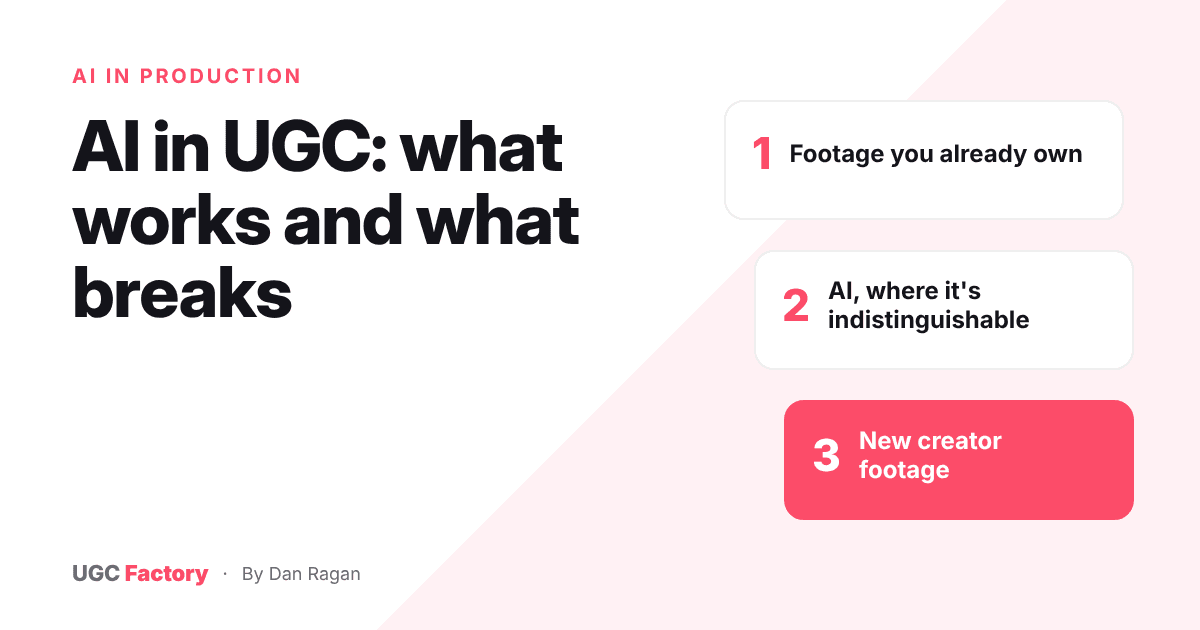
Table of Contents
Every UGC agency now says it uses AI. Very few say where it fails.
We've spent the last year rebuilding our production process around AI: research, briefs, footage planning, B-roll and editing. Some of it changed how we work for good. Some of it produced work we'd never put in front of a client. This is an honest look at both sides.
What works
1. Planning footage like an investment manager
The biggest gain didn't come from generating anything. It came from planning.
For every ad we recommend, we list each clip it needs and describe it in general terms, like "a person holding the product in a kitchen." Then we count how often each clip shows up across the month's ads. AI makes this fast enough to do for every concept.
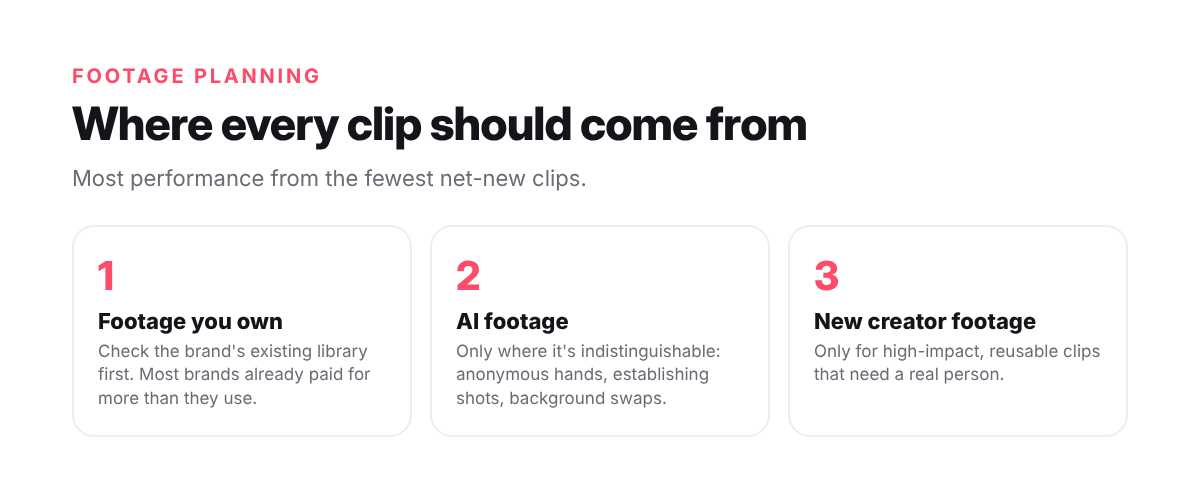
Then we source each clip in a strict order:
Footage the brand already owns.
Footage AI can create convincingly.
Net-new creator footage, only when a clip is high-impact and reusable.
The goal is to get the most performance out of the fewest net-new clips. Most of the industry treats footage as churn and burn: film it, use it once, throw it away. Clips can and should be recycled across many ads.
2. AI footage, but only where it's indistinguishable
We use AI for footage nobody can tell apart from the real thing: B-roll of anonymous hands using a product, establishing shots, or swapping a creator's background for a setting that fits their role. Background replacement works especially well on footage shot on a tripod.
What we don't hand to AI is the creator's core performance. The talking, the reactions and the moments only a real person can make believable stay human. That line is the difference between AI-assisted UGC and AI slop.
3. Editors become assemblers
When clips arrive organized, labeled and tied to the reference ad they're meant to recreate, editing changes. The editor's job shifts from hunting through folders to assembling: drag clips onto a timeline, apply pre-approved captions, music and text overlays, and refine. AI suggests visual treatments for each beat of the script. The result is several times more finished edits per editor per day.
4. AI working inside the editing software
The newest shift is AI controlling professional editing tools directly. With newer integrations, a model like Claude can drive software such as DaVinci Resolve. In our tests it handled simple edits on its own: speeding up footage, trimming silences and normalizing audio. We also feed it client feedback from call transcripts and have it propose revisions.
It's early, and complex creative edits still need a human. But for repetitive, mechanical edits, this is the biggest change we've seen in a couple of years.
5. Taste becomes the job
When producing an edit gets cheap, deciding what's worth producing becomes the scarce skill. The value moves to judgment: which concept to make, which take is believable, which hook earns the scroll stop. AI made our strategists and creative directors more important, not less.
What still breaks
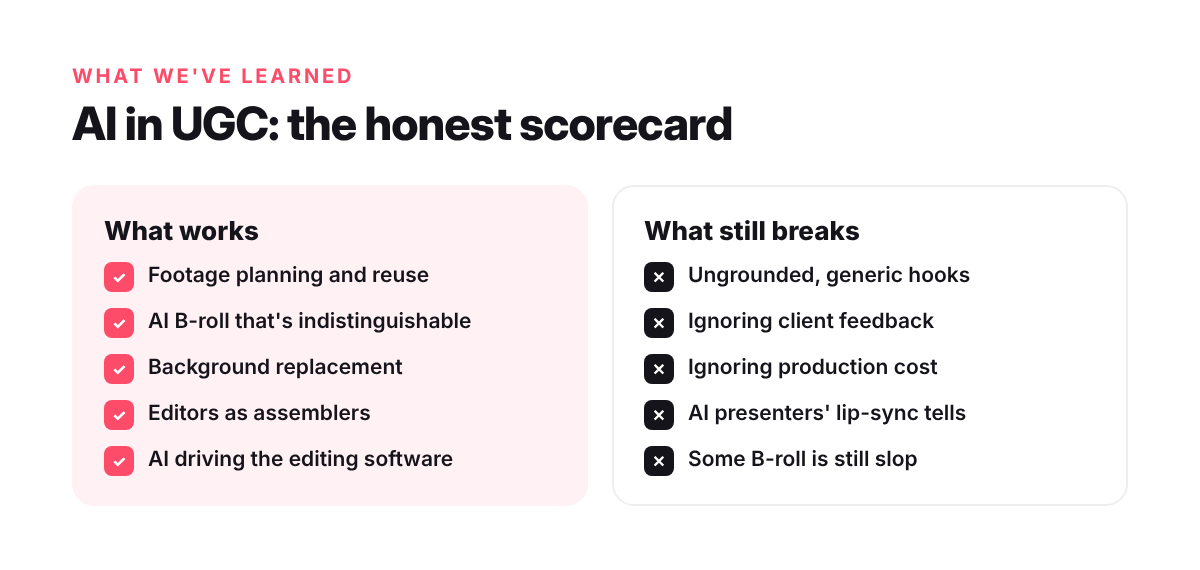
1. Ungrounded AI output reads as generic
Hooks and scripts written by AI from a blank prompt look exactly like that. They're grammatically perfect and instantly forgettable. The fix was grounding: generating from real, top-performing ads in the category instead of from the model's general sense of what an ad sounds like.
2. It ignores client direction
Automated brief pipelines are bad at remembering what a client already said no to. We've seen a system recommend a format the client had explicitly rejected, and suggest a reference ad that wasn't a top performer at all. Our rule now: if a reference isn't a proven winner, we never recommend it. Every brief gets checked against everything the client has told us before it goes out.
3. It ignores production cost
AI will happily recommend a concept that needs 40 unique creator B-roll shots. On paper it's a strong idea. In practice it blows the budget and the timeline. Clip economics (what it actually costs to film each recommendation) has to be built into the logic, not checked afterward.
4. More output isn't better output
AI makes it easy to produce huge briefs packed with internal labels, scores and options. Clients don't want that. A brief that makes a client ask "what is all this?" has failed, however thorough it is. Editing AI output down is now a core part of the job.
5. AI actors still have tells
Lip-sync lag and slightly off expressions on AI-generated presenters are still common, and clients notice. We treat AI presenters as a testing tool, not a replacement for real creators in ads meant to scale.
6. Some AI B-roll is still slop
Not every generated clip is good, even when it's technically impressive. Some of what we made a few months ago doesn't hold up today. Interestingly, rougher AI footage sometimes still converts with certain audiences, but that's a reason to test it, not to assume it.
7. Platform risk
Platforms are paying close attention to low-quality AI content, and we expect them to keep getting stricter. Brands that lean too hard on fully AI ads are building on ground that may shift. Real creator footage, used well, is the safer foundation.
The rules we follow
AI never replaces the creator's core performance.
Every generated hook and concept is grounded in real winning ads.
Every brief is checked against the client's past feedback before it ships.
We never mix footage from two different creators in one ad.
A human with taste approves everything that goes to a client.
The bottom line
AI is very good at the parts of UGC production nobody should be doing by hand: planning, organizing, recombining and mechanical editing. It's still unreliable at judgment, at remembering context, and at being believable on camera. The best results come from pairing the two: AI for leverage, real creators for trust, and people with taste deciding what ships.
Curious how this would work with your existing footage? Book a strategy call. We'll show you how much of your library can be put back to work. Related reading: why we test statics before video.
About Dan Ragan
Founder of UGC Factory and expert in user-generated content marketing strategies. With over 10 years of experience in digital marketing, Dan helps brands leverage authentic content to drive engagement and conversions.