The Flat-Fee UGC Retainer Is Dying. Here's What Replaces It
Founders now know what UGC should cost. Why flat-fee retainers are fading, how performance creative deals work, and what DTC brands should buy instead.
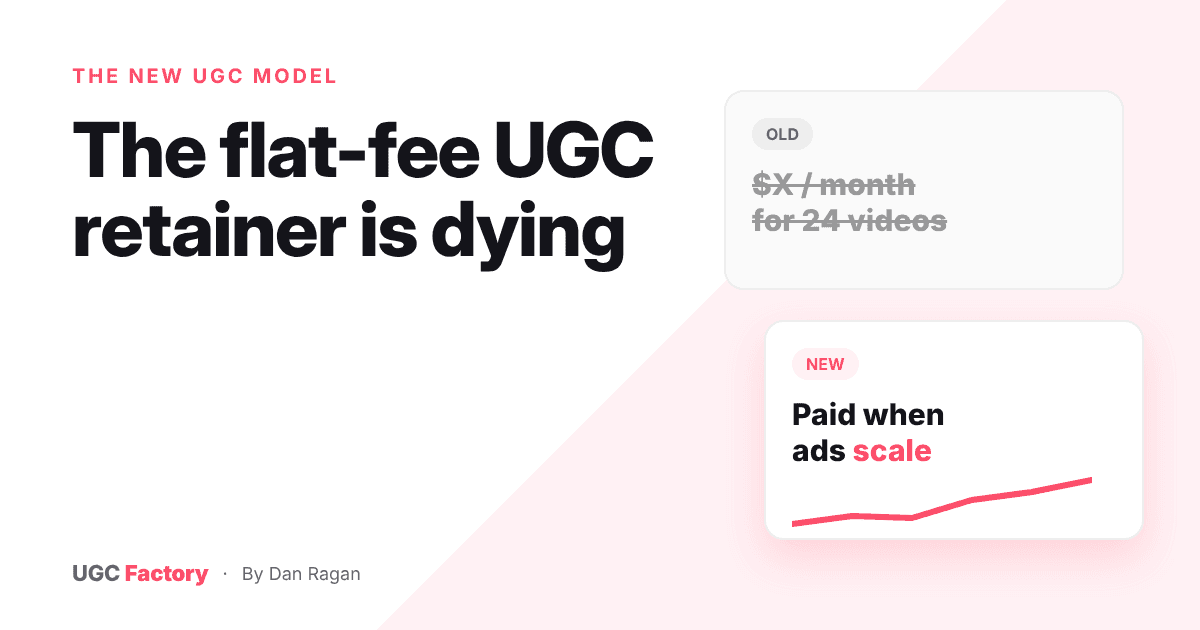
Table of Contents
Founders finally figured out what UGC is, what it should cost, and what they've been overpaying for.
That one shift is quietly breaking the way most UGC agencies sell. The classic offer (a flat monthly fee for a set number of videos, locked in for three months or more) made sense when UGC was new and nobody knew the going rate. Today, most DTC operators we talk to can tell you to the dollar what a creator video costs on a marketplace, and they're asking a harder question: what am I actually paying the agency for?
Here's what changed, why the flat-fee model is struggling, and what we think replaces it.
What changed in the market
Three things happened at once.
1. The price floor collapsed
Creator marketplaces made raw UGC a commodity. Industry benchmarks for 2026 put the typical creator video at roughly $150 to $300, with beginners closer to $100. Brands that go direct to creators can pay less than that. Creators who wouldn't film for under $1,000 a few years ago now happily take a fraction of it.
When the raw asset costs that little, a retainer priced on "number of videos delivered" has nothing left to stand on.
2. DTC margins got squeezed
Rising media costs and AI-driven competition compressed margins across the category. Every line item is getting audited, and creative is one of the easiest to question because its value is hard to see on a P&L.
3. Commitments shrank
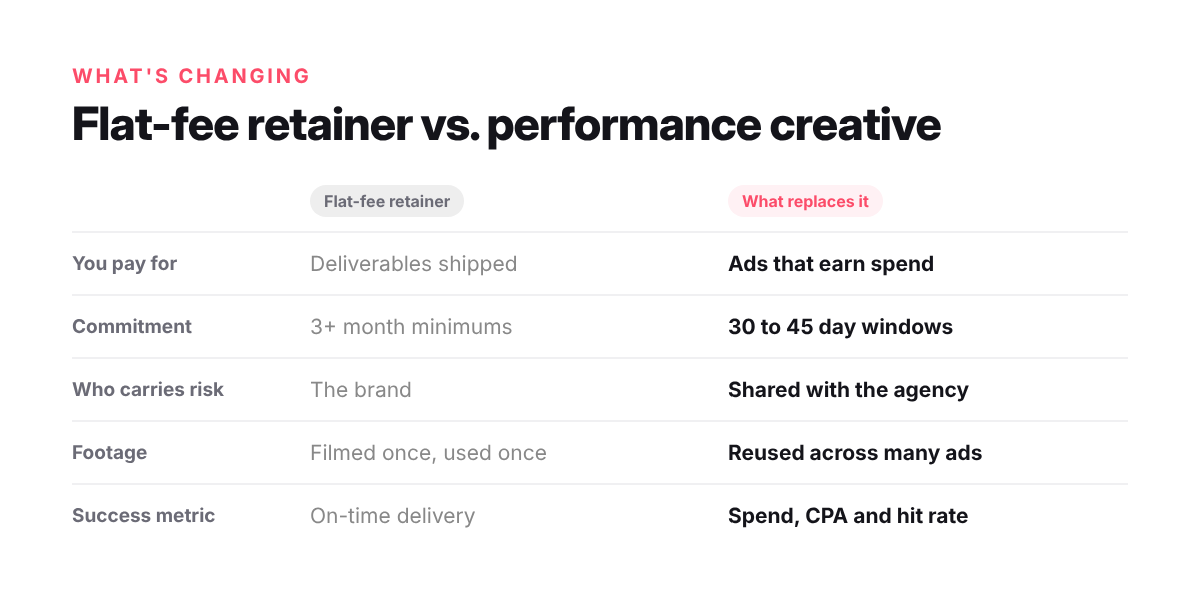
Brands don't want to sign up for a quarter of output before they've seen a single winner. In our conversations, the appetite has moved toward 30 to 45 day windows. Long minimums are getting harder to justify unless the agency can show why the time is needed to find winners.
Why the flat-fee retainer breaks
The core problem is incentives. A flat fee pays the agency for deliverables, not outcomes. The agency's job becomes shipping 20 or 30 files a month on time. Whether any of them scale is the brand's problem.
That puts all of the risk on the brand. And most brands can afford a fee. What they can't afford is paying the fee and having nothing work.
It also explains why creative agency relationships are famously short. When the only thing tying a brand to an agency is a monthly invoice, the first flat month ends it. The model isn't sticky because the value isn't compounding.
What replaces it
We see three changes taking hold. The strongest offers in the market combine all three.
1. Pricing tied to performance
More agencies are moving to pricing tied to results. Some charge a percentage of the ad spend running on their creative, and offers around 10% of spend are starting to show up. Others tie fees to revenue for one-time-purchase brands.
We think spend is the cleanest metric. Meta's algorithm puts dollars behind the ads that work, so spend is the platform's own vote. Last-click CPA and attributed revenue are noisier. A video ad often opens the funnel, and then a static or a retargeting ad gets the click credit. Pay only on last click and the creative that started the sale gets nothing.
A simple habit that changes how you read your account: sort your ads by spend or impressions, not by CPA. The ads the algorithm keeps feeding are your real winners, even when a smaller ad shows a prettier CPA on less volume.
2. Volume with intent
Performance creative is a numbers game, but not a random one. You de-risk it by taking a lot of swings at well-researched concepts, not three polished videos a month. One scaled winner can produce for months as it slowly fatigues, which is why the value builds month over month instead of resetting.
The catch: volume only works if the brand gives the ads enough test budget. A performance partner can't prove anything on ads that never get spend.
3. Systems, not just creators
Access to creators is no longer the moat. Anyone can find creators. What's scarce is the system around them:
Strategy grounded in data: concepts built from what's actually scaling in your account and your category, not brainstorms.
A bench of coachable creators: people who take direction well and film usable footage, not just big followings.
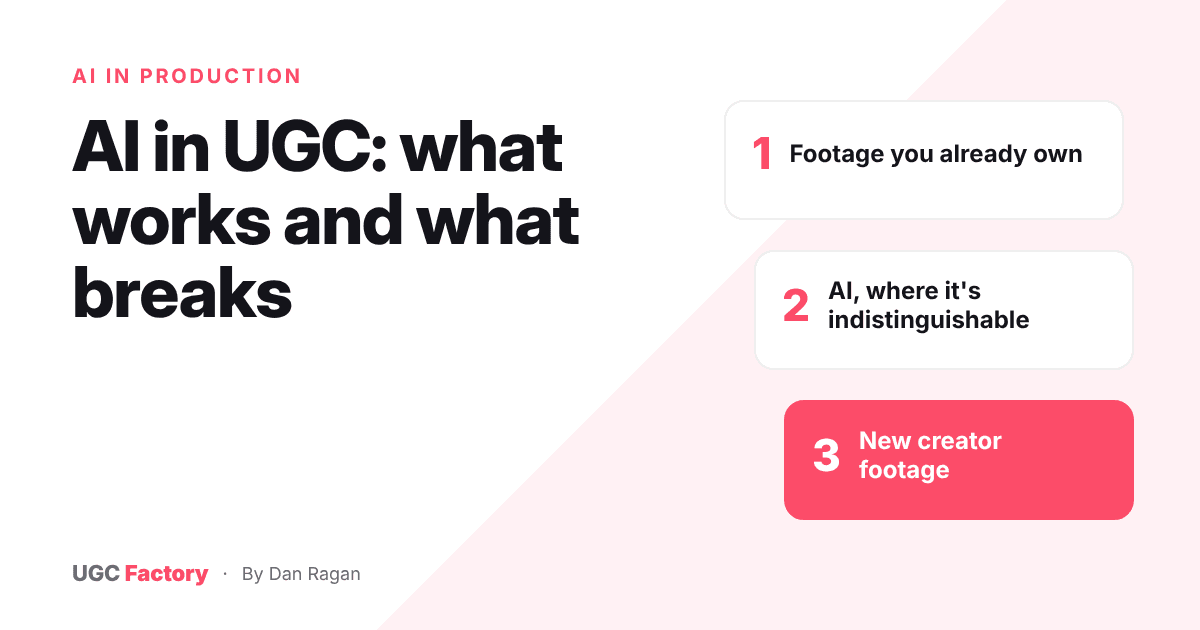
A footage engine: clipping, recombining and reusing the footage you already own, with AI B-roll where it's indistinguishable from the real thing.
Most of the future value sits in that last part. Footage should be recycled across many ads, not filmed once and thrown away.
What about taking it in-house?
A lot of founders are building their own creator programs: hiring an affiliate manager, recruiting creators directly and running partnership ads themselves. It can work. It usually stalls for one boring reason: footage organization.
Open most brands' content drives and you'll find dated folders, mixed products and a library that's mostly talking heads with very little reusable B-roll. If you want an in-house UGC engine, you need to be organized enough to find and reuse what you've already paid for. Without that, you end up buying the same shots over and over.
We broke down the full tradeoff in UGC agency vs. creator platforms vs. in-house.
The creator army trap
The hot model right now is the commission-only "creator army": hundreds of creators posting and getting paid a cut of sales. It feels like free reach. In practice, a bench doesn't run itself. Someone has to recruit, brief, review, approve and pay all of those people, and most of the output is unusable for paid ads.
It's the same pattern as a few years ago, when every brand decided it "needed UGC" without a plan for what to do with it.
What DTC brands should actually buy
If you're evaluating creative partners right now, look for:
Aligned incentives. Some part of the partner's upside should depend on your ads scaling.
Short commitments, earned renewals. Confidence shows up as willingness to prove it quickly.
Strategy before production. You should approve data-backed concepts before anyone films anything.
Clear footage terms. Know who owns raw footage and how it can be reused, so the library you pay for keeps working for you.
Partnership ads access. Meta has reported that partnership ads deliver meaningfully lower CPA and higher click-through than standard brand ads, so creators should be set up to run them.
For the full checklist, see 12 questions to ask before hiring a UGC agency.
The bottom line
The flat-fee retainer isn't disappearing overnight, but it's losing the argument. Brands now know what a video costs. The agencies that win from here will sell outcomes and systems, and carry some of the risk alongside the brand.
If you want to see how that would look for your account, book a strategy call and we'll walk through what's scaling in your category.
About Dan Ragan
Founder of UGC Factory and expert in user-generated content marketing strategies. With over 10 years of experience in digital marketing, Dan helps brands leverage authentic content to drive engagement and conversions.