UGC Agency vs. Creator Platforms vs. In-House: Which Fits Your Brand?
An honest comparison of hiring a UGC agency, using a creator platform like Billo or Insense, or building in-house: cost, control, speed and who each fits.
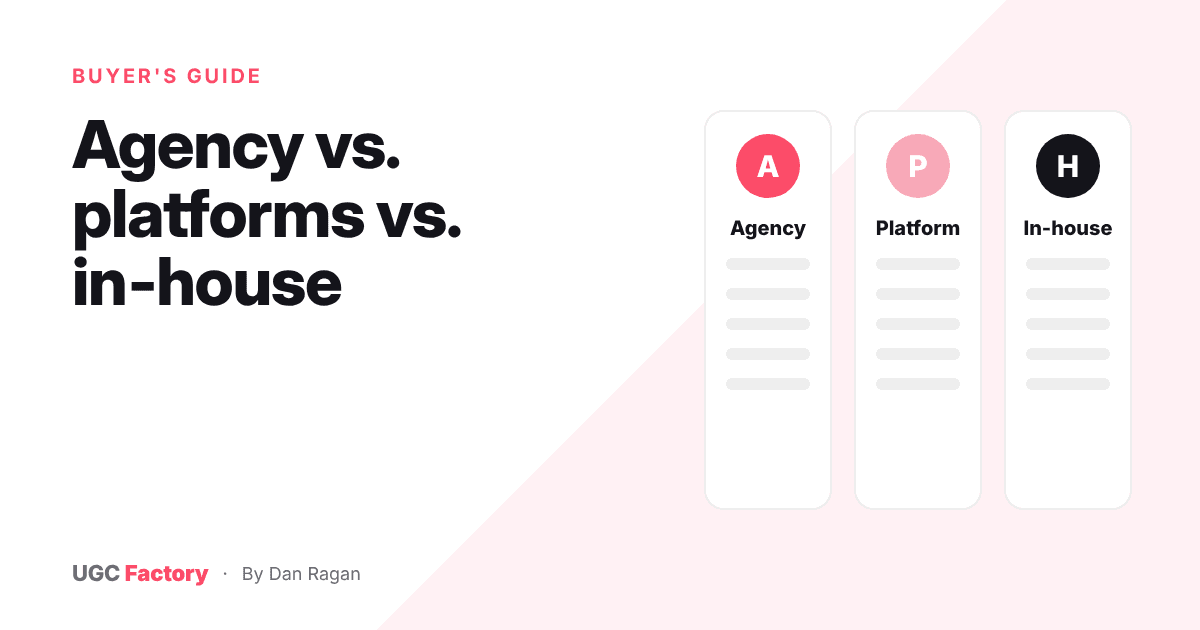
Table of Contents
Every DTC brand that runs paid social ends up with the same question: who should make our UGC ads?
There are three real options. Hire a UGC agency, use a creator platform, or build the capability in-house. Each one works well for some brands and badly for others. This guide compares them honestly, including where an agency like ours is the wrong choice.
The quick comparison
| UGC agency | Creator platform | In-house | |
|---|---|---|---|
| Who does strategy | Agency | You | Your team |
| Who finds creators | Agency | Platform pool, you choose | Your team |
| Who edits ads | Agency | Usually you | Your team |
| Your time per week | Low | Medium to high | High |
| Cost structure | Monthly fee or performance-based | Subscription plus creator fees | Salaries plus creator fees |
| Speed to first ads | 2 to 4 weeks | 1 to 3 weeks for raw footage | Months to build |
| Best for | Brands that want strategy and output without building a team | Brands with in-house strategy and editing | Brands spending heavily with organized operations |
Creator platforms
Platforms like Billo, Insense and similar marketplaces give you access to a large pool of creators and tools to post briefs, review submissions and pay people.
Where they shine
Low entry cost. Self-serve plans start at a few hundred dollars a month, plus creator fees.
Volume of raw footage. Great when you need a lot of product-in-hand content quickly.
Control. You pick every creator and write every brief.
Where they fall short
Strategy is on you. The platform delivers what you brief. A weak brief gets a weak video.
Raw footage isn't an ad. Someone still has to cut hooks, add captions and build variations.
Quality varies. Expect to vet heavily and reshoot more often.
Choose a platform if you already have a creative strategist and an editor, and mainly need more raw footage.
Building it in-house
More founders are building their own creator programs: hiring an affiliate or creator manager, recruiting creators directly and running partnership ads from their own accounts.
Where it shines
Deep brand knowledge. Nobody knows your customer like your team.
Long-term creator relationships. Creators who work with you for months get better and cheaper over time.
Cost at scale. At high volume, going direct to creators is the cheapest cost per asset.
Where it falls short
It takes a team. You need someone on strategy, someone managing creators and someone editing, at minimum.
Footage chaos. In-house programs usually stall on organization. Most brand content libraries are a mix of dated folders, mixed products and talking heads with little reusable B-roll. If you can't find and reuse what you've already paid for, you'll keep paying for the same shots.
Slow to start. Hiring and building the process takes months before the program runs smoothly.
Choose in-house if you're spending heavily on paid social, can hire at least two dedicated people, and are willing to invest in organizing your footage.
A UGC agency
An agency combines strategy, creator sourcing, production and editing into one service.
Where it shines
Strategy built in. Good agencies start from your ad account and your competitors, not a blank page.
Finished ads, not footage. You get edited, ready-to-launch ads with hook variations.
Vetted creators. Less time sorting through submissions and fewer reshoots.
Low management load. Your team approves; it doesn't produce.
Where it falls short
Higher upfront cost than buying raw footage, at least per video.
Less day-to-day control over every creator choice.
Commitments. Many agencies ask for multi-month contracts, so read the terms.
Choose an agency if you want a steady flow of tested, finished ads without building a team, and your bottleneck is strategy and execution rather than raw footage.
One factor that applies to all three: partnership ads
Whichever route you choose, set creators up to run partnership ads, where the ad runs from the creator's handle as well as yours. According to Meta's own research, cited by a former member of Meta's sales team, partnership ads deliver about 19% lower cost per acquisition and 53% higher click-through than standard brand ads. Make sure your contracts and briefs include partnership ad access.
The hybrid most scaling brands land on
In practice, many brands mix the options. A small in-house team owns brand voice, creator relationships and the footage library. An agency adds strategy, testing volume and editing capacity. A platform fills gaps when they need extra raw footage fast.
The key is a single owner for strategy, so every piece of content ladders up to a testing plan instead of piling up in a folder.
How to decide in five minutes
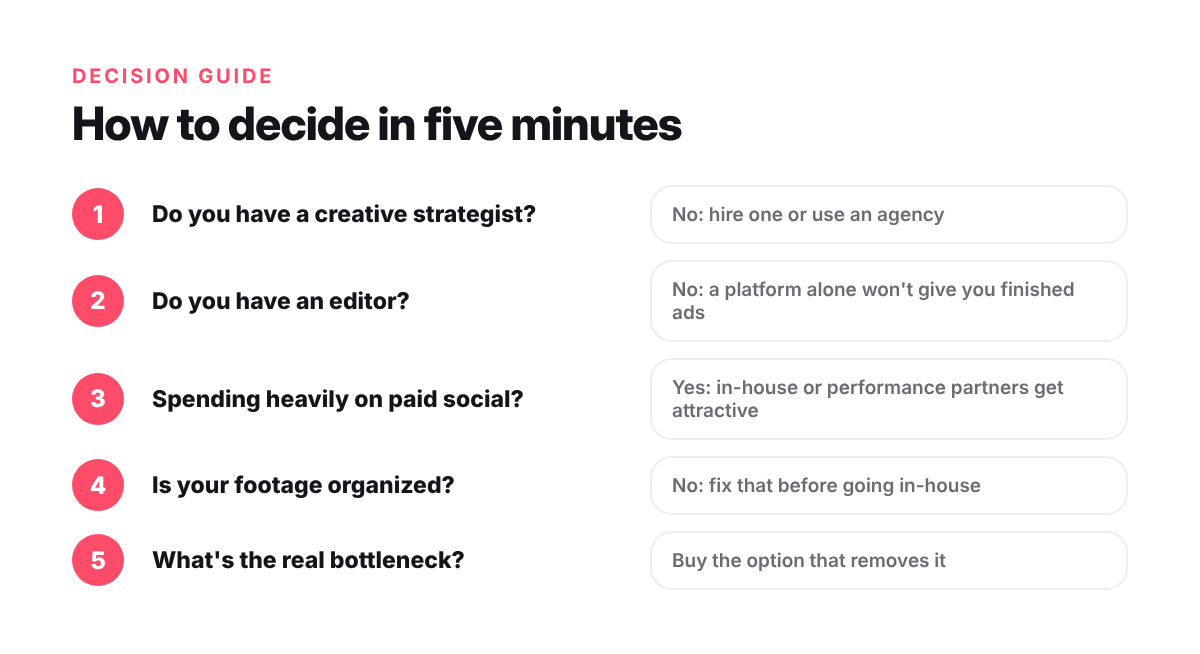
Do you have a creative strategist today? No: you need an agency, or you need to hire one.
Do you have an editor? No: a platform alone won't get you finished ads.
How much are you spending on paid social? Heavy spend makes in-house or performance-based partners more attractive.
Is your footage organized? No: fix that before you build in-house.
What's your real bottleneck: ideas, footage or editing? Buy the option that removes that bottleneck.
For pricing details across all three, see how much a UGC agency costs. If you're leaning toward an agency, read 12 questions to ask before hiring one, or book a strategy call and we'll tell you honestly which option fits your brand.
About Dan Ragan
Founder of UGC Factory and expert in user-generated content marketing strategies. With over 10 years of experience in digital marketing, Dan helps brands leverage authentic content to drive engagement and conversions.