12 Questions to Ask Before Hiring a UGC Agency
Get past the sales pitch. 12 questions that reveal how a UGC agency really handles strategy, creators, testing, rights and results, with good answers.
Table of Contents
Hiring the wrong UGC agency doesn't just waste a retainer. It burns a quarter of testing time and leaves you with a folder of ads that never scaled.
Most agency sales calls sound the same: great creators, fast turnaround, impressive logos. These 12 questions get past the pitch and show you how an agency actually works. We've included what a good answer sounds like for each.
Strategy
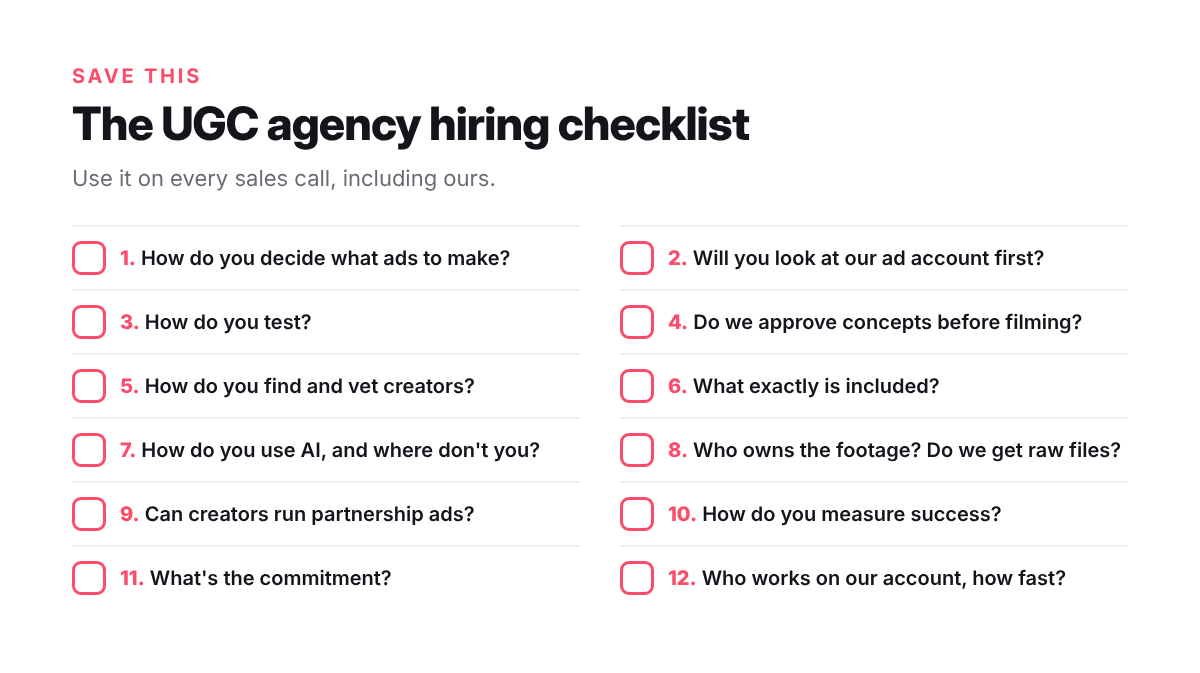
1. How do you decide what ads to make?
Good answer: they start from data. Your own ad account first, then direct competitors, then what's working across your category, plus customer reviews and real customer language.
Red flag: "Our creative team brainstorms concepts." Brainstorms aren't a strategy.
2. Will you look at our ad account before you pitch concepts?
Good answer: yes. They want to see what's already working, what fatigued, and which creators performed before recommending anything.
Red flag: concepts arrive before anyone has asked for access.
3. How do you test?
Good answer: a clear testing structure. For example, testing messages cheaply with statics first, isolating one variable at a time, and producing multiple hooks for each concept. (Here's why we test statics before video.)
Red flag: "We'll send you ads and you test them."
4. Do we approve concepts before anything gets filmed?
Good answer: yes. You see the concepts, reference ads and scripts or talking points up front, so changes happen in pre-production, not in costly reshoots.
Creators and production
5. How do you find and vet creators, and can we approve them?
Good answer: a vetted bench, matched to your customer profile, with creator options shown to you before casting is final.
Red flag: follower count is their main selection criterion. For paid ads, you want creators who take direction well and feel believable to your buyer.
6. What exactly is included?
Get a specific list: number of finished ads per month, hook variations, statics, scripts, editing rounds, captions and formats. "24 videos" means very different things at different agencies. Ask whether those are finished, edited ads or raw clips.
7. How do you use AI, and where don't you?
Good answer: a specific, honest answer. AI for research, planning and B-roll that's indistinguishable from real footage. Real creators for the performances that build trust.
Red flag: either "we don't use AI" (you're paying for inefficiency) or "it's all AI" (you're taking on quality and platform risk). We wrote up what works and what still breaks.
Rights and ownership
8. Who owns the footage, and do we get raw files?
Good answer: clear, written terms on licensing, duration and raw files. Your footage library is an asset that should keep working for you long after the original ads fatigue.
Red flag: vague answers, or usage rights that expire quietly.
9. Can creators run partnership ads for us?
Good answer: yes, and they set it up as standard. Meta's research, cited by a former member of its sales team, shows partnership ads delivering about 19% lower CPA than standard brand ads, so this shouldn't be an upsell.
Performance and terms
10. How do you measure success?
Good answer: they talk about which ads earn and hold spend, cost per acquisition, and hit rate, not just "we delivered 24 videos on time." Bonus points if they look at which ads the algorithm keeps funding rather than only last-click CPA.
Red flag: success is defined as on-time delivery.
11. What's the commitment, and what happens if it isn't working?
Ask about contract length, notice periods, and what the agency changes when a batch underperforms. A good partner has a plan for the second month that depends on what the first month taught them. Some agencies now offer performance-based terms, which we cover in why the flat-fee retainer is dying.
12. Who works on our account, and how fast do they respond?
Good answer: a named strategist, a clear communication channel and fast response times. In paid social, a slow agency costs you money every day a winning idea sits unlaunched.
Green flags worth paying for
They ask about your margins, CPA targets and spend before talking about deliverables.
They show you real ads and real results from brands in your category.
They push back on ideas they think won't work.
They can explain why each concept should work, citing data.
Red flags to walk away from
No interest in your ad account.
Pricing only per video, with rights, raw files and hooks as surprise add-ons.
Case studies with no numbers, or numbers they won't explain.
Long commitments with no plan to adjust.
The bottom line
The right agency should feel like an extension of your growth team: data-first on strategy, rigorous on testing, clear on rights and fast on execution. Use these questions on every call, including ours.
Want to put us through it? Book a strategy call, and see our case studies for results from brands in your category. For budgeting, read how much a UGC agency costs.
About Dan Ragan
Founder of UGC Factory and expert in user-generated content marketing strategies. With over 10 years of experience in digital marketing, Dan helps brands leverage authentic content to drive engagement and conversions.